
ByeGig 2026
How Companies Can Actually Use Premium Domains
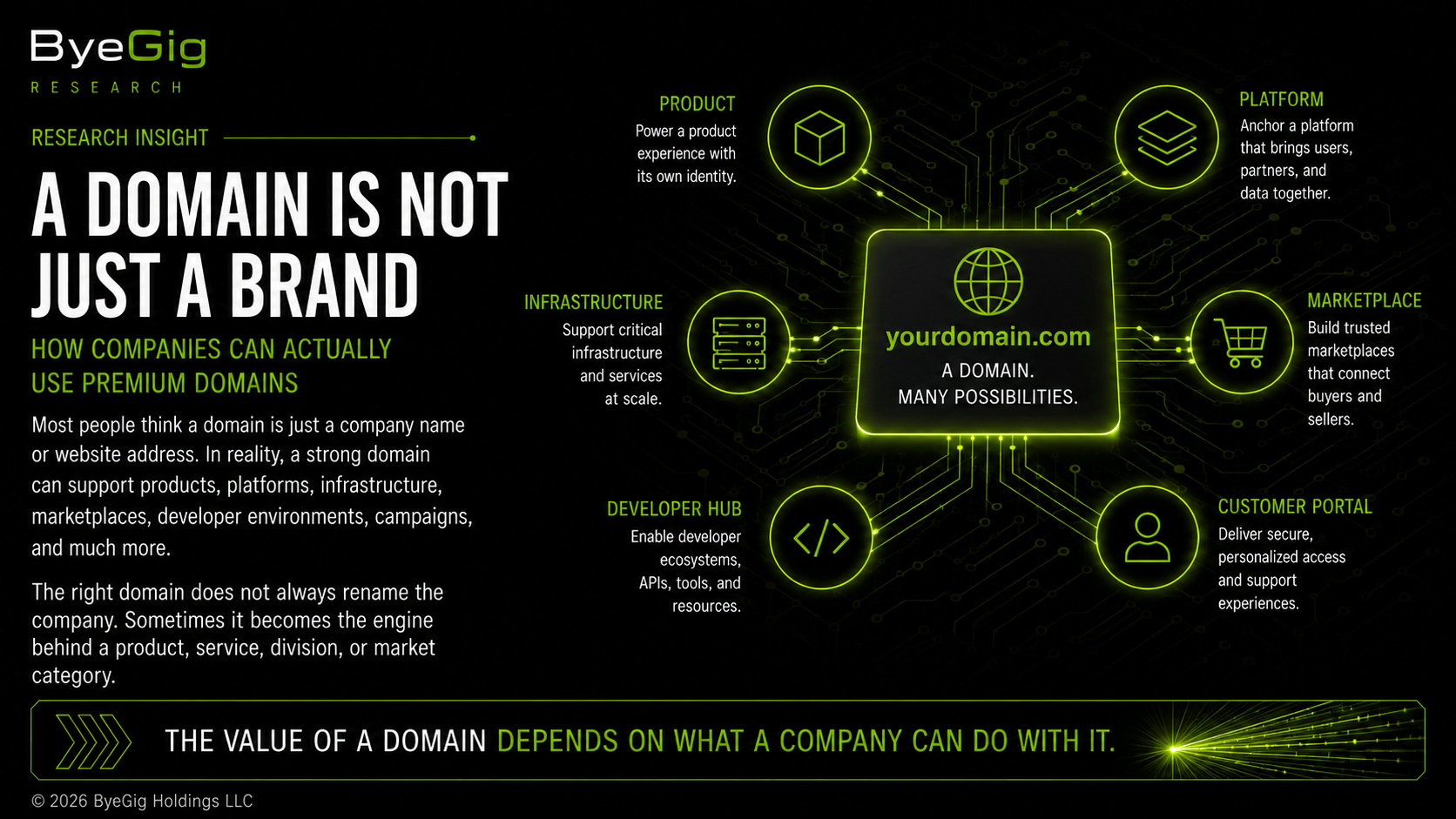
Most people still think about domains in roughly the same way they did 20 years ago. A company chooses a name, buys the matching domain, builds a website and uses that address as the front door to the business. In that framework, the domain and the company brand are basically the same thing.
That is one use of a domain, and an important one. But it is nowhere close to the only one.
A domain can be the name of a company, but it can also be the name of a product, a technical platform, a new business unit, a developer environment, a customer portal, a marketplace, a research initiative, a sales funnel, an industry coalition, a defensive asset or a piece of digital infrastructure. It can be central to a company or useful to one small division inside a much larger organization.
That distinction matters because when people look at a domain such as ComputeAllocator.com, HumanoidControlPlane.com, RuntimeContainment.com or ComputeSettlementNetwork.com, they often ask the same question: “What company would rename itself that?”
In many cases, that is the wrong question.
The better question is: What could a company do with it?
The Most Obvious Use Is Still Branding
There are plenty of situations where the traditional use makes perfect sense. A startup may acquire a strong domain and build the entire company around it. A robotics startup could decide that a name describing its core technology is better than the working name the founders started with. A cybersecurity company could acquire a domain that immediately tells enterprise buyers what problem it solves. A financial infrastructure startup may want a name that clearly establishes it within settlement, clearing or liquidity.
For a young company, this can be particularly valuable because there may not be much existing brand equity to abandon. The domain can become the company, the website, the email identity and the shorthand explanation of what the business does.
ByeGig owns plenty of domains that can be viewed this way. Some are naturally brandable. Some are technical. Some fall somewhere between the two.
The mistake is assuming every domain must pass this test.
A Buyer Usually Does Not Need to Rename the Company
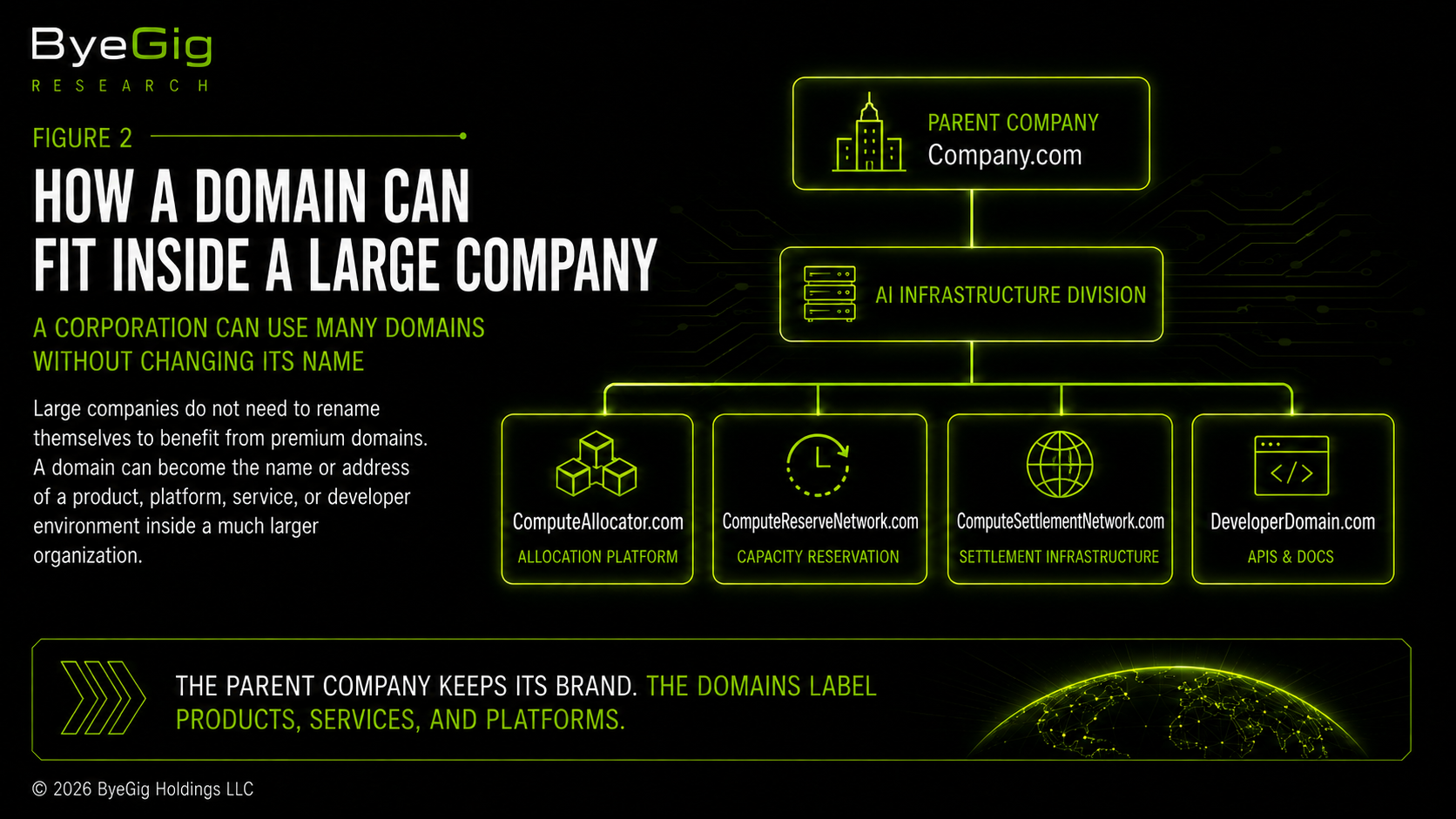
Consider a large technology company launching a new system for allocating GPU capacity. The corporation may already have one of the most recognizable brands in the world. There would be no reason for it to change its corporate name.
It could still have a perfectly good reason to own ComputeAllocator.com.
The company might use it as the name of the product. It could use it for a customer-facing portal. It could host documentation there. It could redirect the address to a product page inside the company's main website. It could use the name internally for an entire business line and externally when marketing that capability.
The value of the domain does not depend on the parent company changing its identity.
This happens throughout business. Large companies operate many products, services, platforms and divisions beneath one corporate brand. Those individual pieces still need names, addresses and identities.
Domains can fit anywhere inside that structure.
Domains Can Be Product Names
This is one of the simplest ways to expand the way people think about domains.
Companies launch products constantly. Those products need names even when the corporate name never changes.
A robotics manufacturer might launch a fleet-management platform and use RobotFleetNetwork.com. An AI security company could launch an agent containment product using RuntimeContainment.com. A defense contractor could introduce a software product around DefenseDecisionEngine.com. A cloud infrastructure company might build a capacity product around ComputeReserveNetwork.com.
Each one could theoretically become a company name, but none of them has to.
For a product manager inside a large organization, buying a domain may be a relatively small part of a much larger launch budget. The engineering work, staff, marketing, sales, infrastructure and customer support surrounding the product could cost millions of dollars. Acquiring the right domain may be one of the smaller decisions involved.
That leads to another point that I think gets overlooked in the domain market.
The Reason for Buying a Domain Does Not Have to Be Enormous
People sometimes evaluate premium domains as though a purchase needs to justify changing the direction of an entire company.
It does not. A $50 billion company may buy a domain for a product representing a tiny portion of its business. A division may need it. A product team may want it. A marketing group may use it for a campaign. An engineering organization may want a clean address for a developer platform.
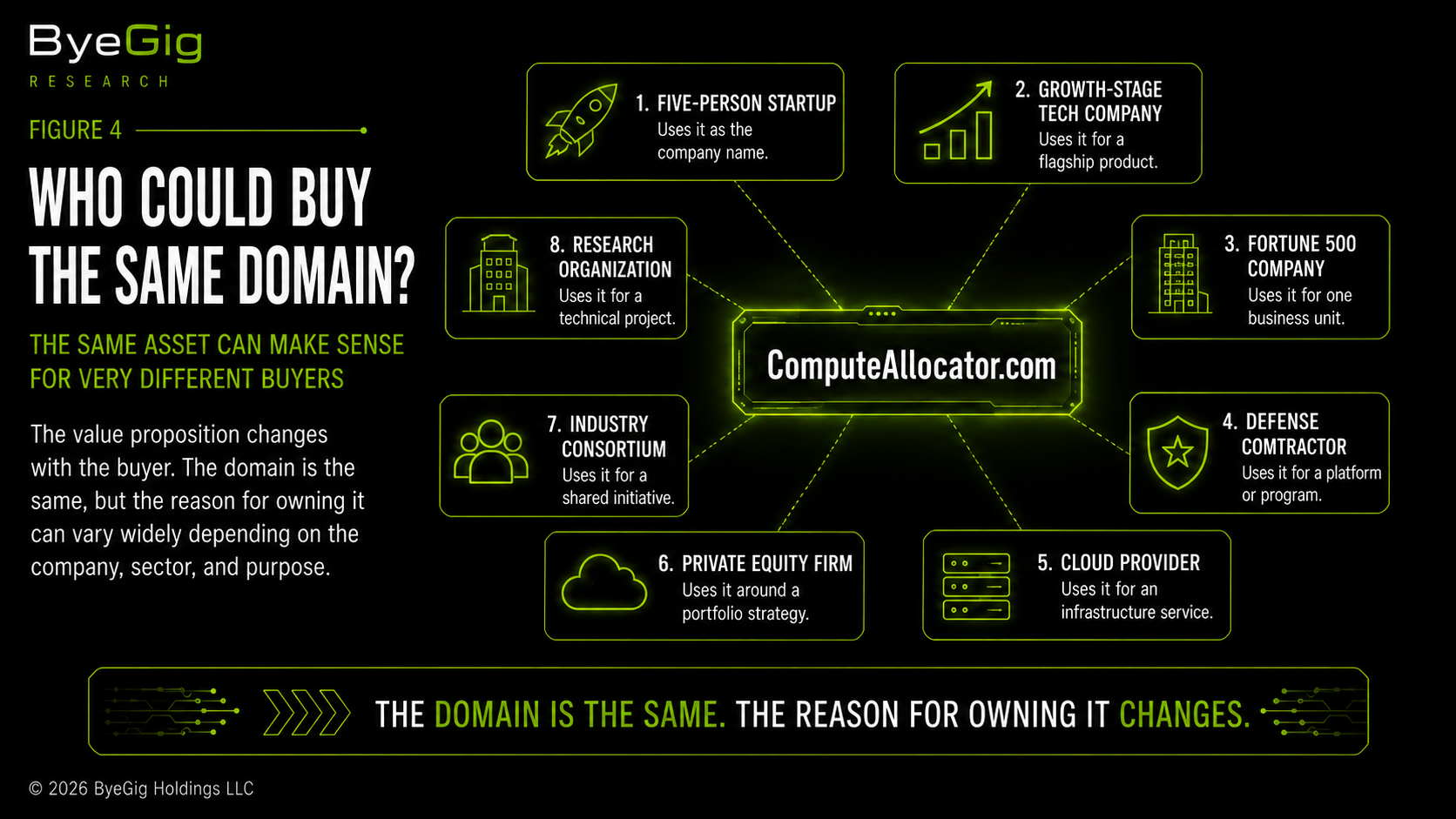
The domain could be used by a few dozen employees inside a company with 100,000 people and still make complete economic sense. At the opposite end of the spectrum, a five-person startup might buy exactly the same domain and make it the foundation of the entire company.
Same asset. Completely different reason for owning it.
This is important when thinking about potential buyers for ByeGig domains. The addressable market is not limited to companies willing to adopt the domain as their corporate identity. It includes companies that simply have a use for it.
Some Domains Are Really Infrastructure
This is where the traditional branding view becomes especially limiting.
A domain does not necessarily exist primarily for a person typing it into a browser. In technology, domains can sit inside the actual operating architecture of a product.
A software company might already use addresses such as:
There is nothing unusual about this. These addresses organize different parts of the company's technology stack.
Independent domains can do the same thing.
AgentRuntime.com could become an execution environment for AI agents. AuthenticationControlPlane.com could identify an authentication service. GPUInterconnect.com could sit behind networking software or developer resources. MachineIdentityFabric.com could identify an identity layer designed for machines and autonomous agents.
The domain might lead to a dashboard, API, documentation center, customer console or infrastructure service. In some cases, humans may barely interact with it at all.
At that point the domain is not simply marketing.
It is part of the architecture.
Descriptive Domains Can Help Own a Category
There is another use that sits between brand and infrastructure.
A company can own the domain describing the market category it wants to lead. This can be especially interesting in emerging technology because the terminology is still developing. Today, phrases such as machine identity, physical AI, sovereign compute, agent runtime, agent containment, AI control plane and compute settlement are becoming part of the vocabulary surrounding new technology markets.
No one knows which terms will ultimately become massive categories and which will fade away. That is part of the opportunity. If a company believes a particular term will become important, owning the exact domain can give it a natural home for educational content, white papers, customer resources, research, product information and industry discussion.
The domain does not magically make the company the category leader. Execution still matters far more. But it can help a company plant a flag around the language it wants to own.
There is a meaningful difference between acquiring a clever invented brand and acquiring an exact term that could become part of an industry's permanent vocabulary.
Both can be valuable. They are simply different types of assets.
Become a Marketplace
Certain domains naturally describe places where activity occurs rather than companies.
Words such as Exchange, Market, Network, Clearing, Settlement, Reserve, Liquidity and Marketplace imply interaction.
Take ComputeEnergyExchange.com. The interesting use may not be a company literally called Compute Energy Exchange. It could instead be the address for a market where compute capacity and power economics intersect.
AutonomousComputeExchange.com could identify a marketplace for machine compute. MicrogridExchange.comcould support transactions involving distributed energy resources. GlobalSettlementExchange.com could sit above financial infrastructure connecting multiple participants.
In these cases, the domain tells users what happens there.
Buyers meet sellers. Resources are allocated. Prices are discovered. Transactions are processed. Capacity is reserved. Assets are settled.
That is a very different job from simply being a company name.
A Better Front Door
Sometimes the use is much simpler. Large corporate websites are often difficult to navigate. A company may offer hundreds of products across dozens of divisions. An important capability can end up buried several levels deep inside the site.
A descriptive domain can provide a clean entrance. Suppose a robotics company offers diagnostics specifically for humanoid systems. It could acquire HumanoidDiagnostics.com and redirect it to: company.com/industrial-robotics/autonomous-systems/humanoid/diagnostics
The domain may never host a standalone website. That does not mean it has no value. Its job is simply to make the destination easier to understand, remember and share.
We should think of that as digital navigation infrastructure.
A company might put the domain on a conference booth, brochure, sales presentation or advertisement. A salesperson can say it on the phone. A customer can remember it later. The underlying page can change repeatedly while the domain stays the same.
That alone can be useful.
Sales Tools
A domain can also be purchased specifically because it matches a problem customers are trying to solve.
Imagine a large cybersecurity company whose corporate brand does not describe every individual product it sells. The company may want a domain associated with one particular AI security problem. It could build a landing page around that domain, publish research there, use it in paid advertising, send prospects there from outbound campaigns or make it the destination for a product launch. The domain becomes part of customer acquisition.
This is particularly relevant in enterprise markets where potential customers often search for capabilities rather than companies. A buyer may know it needs agent security, machine identity, runtime protection or model security long before it knows which vendor it wants to buy from.
A descriptive domain can meet the buyer at the problem.
Domains Can Be Temporary
Another misconception is that a premium domain needs to support a permanent corporate identity.
It doesn't.
A company could buy a domain for a product launch that lasts two years. It could use one for a conference, industry initiative, recruiting program, public awareness effort or technical standard. Large companies routinely spend significant amounts of money on temporary projects. Trade shows disappear after three days. Advertising campaigns run for a few months. Consulting engagements end. Software subscriptions expire.
A domain is different because even after the original project ends, the buyer still owns the asset. The company can reuse it, redirect it, hold it or eventually sell it.
Support Research and Internal Projects
Some domains may begin almost entirely inside the organization.
Imagine a semiconductor company researching a new memory architecture, a defense contractor working on autonomous command systems or an AI company building a new agent security layer.
At first, the initiative may simply have an internal code name. As more outside parties become involved, the project may need a cleaner identity.
A domain can host research findings, partner access, documentation, testing environments, technical papers or demonstrations. Universities, suppliers, customers, government organizations and development partners can all interact through it without the company having to turn the project into a separate business.
The domain gives the project a durable identity before anyone knows exactly what it will become.
Developers Are Their Own Audience
A lot of domains are evaluated as if consumers are the only people who matter. In technology, developers may be the primary audience. A company can use a domain as the home for an SDK, API, technical specification, sandbox, integration library, developer community or reference architecture.
Take HumanoidSDK.com. A robotics company could acquire the domain without having any intention of calling itself Humanoid SDK. It might simply want the obvious address for developers building applications on top of its humanoid platform.
The same logic applies across compute, AI infrastructure, cybersecurity and financial technology. Sometimes the best domain is not the one a consumer remembers.
It is the one an engineer immediately understands.
A Domain Can Belong to a Business Unit
Large companies constantly create new divisions and subsidiaries.
An industrial company entering robotics may want a distinct identity for the new operation. An energy business expanding into data centers could create a dedicated compute infrastructure unit. A financial institution entering digital assets may want the new platform separated from traditional banking. A defense company may want an autonomous systems business to have its own outward-facing identity.
The parent company does not need to change its name. The new operation simply gets its own digital property.
This can also help later if the division is sold, spun out, partnered with another company or opened to outside investment.
Help Companies Enter New Markets
A descriptive domain can also be useful when a company is entering a market where its existing brand has little recognition.
A traditional energy company entering AI infrastructure may have tremendous credibility in energy but almost none in compute. A manufacturing business entering robotics may encounter the same problem. A defense contractor entering commercial autonomous systems may want a clearer way to communicate its new capability.
The domain can bridge the gap.
The customer recognizes the capability before it recognizes the company.
That can matter in B2B markets where buyers are often searching for solutions to very specific problems.
Sometimes the Best Use Is Defensive
Not every domain needs an elaborate operating plan.
Sometimes a company simply decides it would rather own the domain than allow someone else to own it.
Corporations do this with intellectual property all the time. They register trademarks they may use later. They buy patents. They secure social handles. They acquire adjacent product names. They protect future areas of expansion.
A domain can play the same role.
If a name is closely related to a company's product, roadmap, industry or strategic direction, ownership itself can have value. The company may simply redirect the domain to its main website and leave it there.
That can still be a rational acquisition.
Industry Groups Can Use Domains Too
The buyer does not even have to be a traditional company. Some future technology markets will require several organizations to work together. AI infrastructure, machine identity, autonomous systems, energy networks and financial infrastructure are all areas where interoperability will matter.
A neutral domain can provide a home for an industry coalition, standards body, research consortium, open-source project or public-private partnership. This is often preferable to hosting the initiative underneath the corporate website of one participant, which can make a joint effort look proprietary.
Here the domain functions as neutral ground.
Think of Domains More Like Corporate Real Estate
One analogy I find useful is real estate.
A company does not own only one physical property because it has only one corporate name. It might have a headquarters, factories, warehouses, laboratories, retail stores, distribution centers and temporary event spaces. Every location serves a different purpose. No one looks at a warehouse and says, “That cannot be valuable because it isn't the company's headquarters.”
Digital property should be viewed the same way. The main corporate domain may be the headquarters.
A product domain may be a storefront.
An API domain may be a factory.
A developer domain may be a laboratory.
A marketplace domain may be an exchange.
A campaign domain might be temporary event space.
A category domain may be more like buying land in a neighborhood because management believes that neighborhood will eventually matter.
Once you stop expecting every domain to serve as the corporate headquarters, the range of potential uses becomes much easier to see.
Brandable and Technical Domains Do Different Jobs
This distinction also explains an important part of the ByeGig strategy.
Some domains are obvious brands. They are short, memorable and flexible enough to support a company with a broad mission.
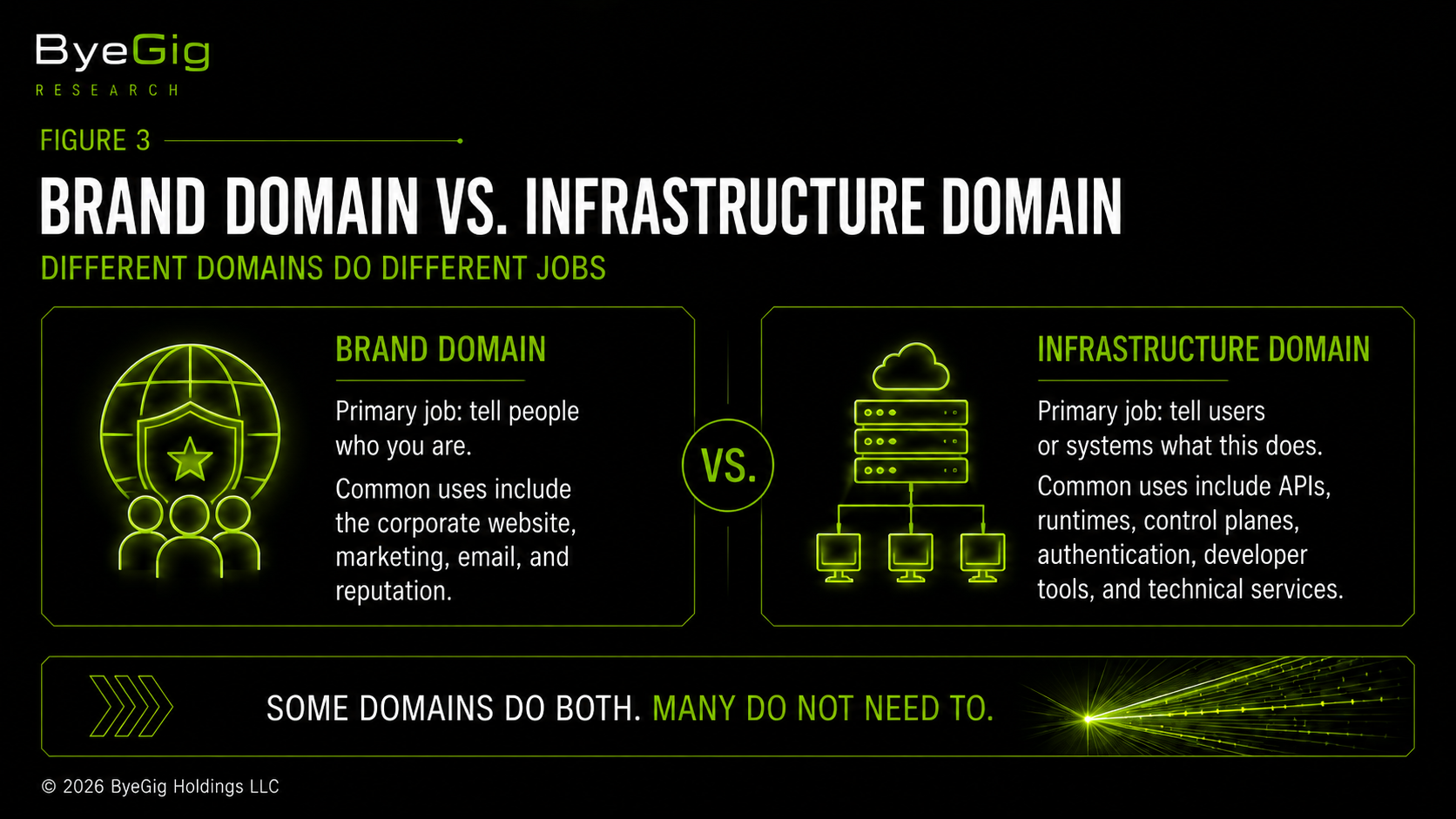
Others are much more technical. They describe a platform, system, layer, network or piece of infrastructure.
A brandable domain is generally trying to answer:
Who are we?
A technical or infrastructure domain is more likely trying to answer:
What does this do?
There are situations where one domain can do both, but there is no reason to require it.
This is especially important in deep technology. A consumer company may benefit from something catchy and abstract. A cybersecurity buyer purchasing mission-critical infrastructure may place much more value on precision. Engineers are not necessarily looking for clever names. They often want to know exactly what something does.
That makes highly descriptive domains unusually interesting in technical markets.
Domains Can Change Jobs Over Time
A domain also does not have to serve the same purpose forever.
A company might initially acquire a domain and redirect it to an existing product page. As the product grows, the company builds a dedicated site. Eventually the product becomes a separate division. Several years later, the business may be spun out and the domain becomes the primary corporate identity.
The reverse can happen too.
A startup launches with a domain as its main brand. A larger company acquires the business. The domain remains the product name for several years and eventually becomes a redirect into the parent's website.
The asset can survive all of those changes.
That flexibility is easy to underestimate.
Put the Cost in Context
Premium domains are also evaluated strangely compared with other corporate expenditures.
Companies routinely spend six figures redesigning websites, running campaigns, attending conferences and hiring consultants. They spend millions launching products and building software. Large organizations spend tens or hundreds of millions entering new markets.
Yet people sometimes evaluate a permanent digital asset attached to one of those initiatives as if anything above a normal registration fee is unreasonable.
The better question is not, “Why does a domain cost this much?”
The better question is, “What is this domain worth in the context of the project using it?”
If a domain makes a product easier to remember, gives a new division a clean identity, strengthens a company's position in an emerging category, improves customer navigation, supports a sales campaign or prevents a competitor from owning an important name, then it should be evaluated against the economics of that purpose.
A $25,000 domain could be absurdly expensive for one company and almost irrelevant to another.
That is true of nearly every business asset.
The Internet Is Becoming More Complicated, Not Less
The first generation of the commercial internet taught businesses that they needed a website.
What is developing now is much larger.
Companies operate corporate sites, applications, developer environments, APIs, customer portals, marketplaces, cloud infrastructure, internal systems and increasingly machine-to-machine services.
AI will probably accelerate that fragmentation.
There will be more autonomous agents, more APIs, more machine identities, more specialized software layers, more infrastructure platforms, more digital marketplaces and more systems interacting without humans directly involved.
Domains are one of the simplest tools available for organizing all of that.
That is why I think the idea that domains are becoming less important misunderstands what is happening. As the digital economy becomes more complicated, companies may need more digital addresses serving more specialized purposes.
Not every one of them needs to be a famous consumer brand.
Many simply need to do their job well.
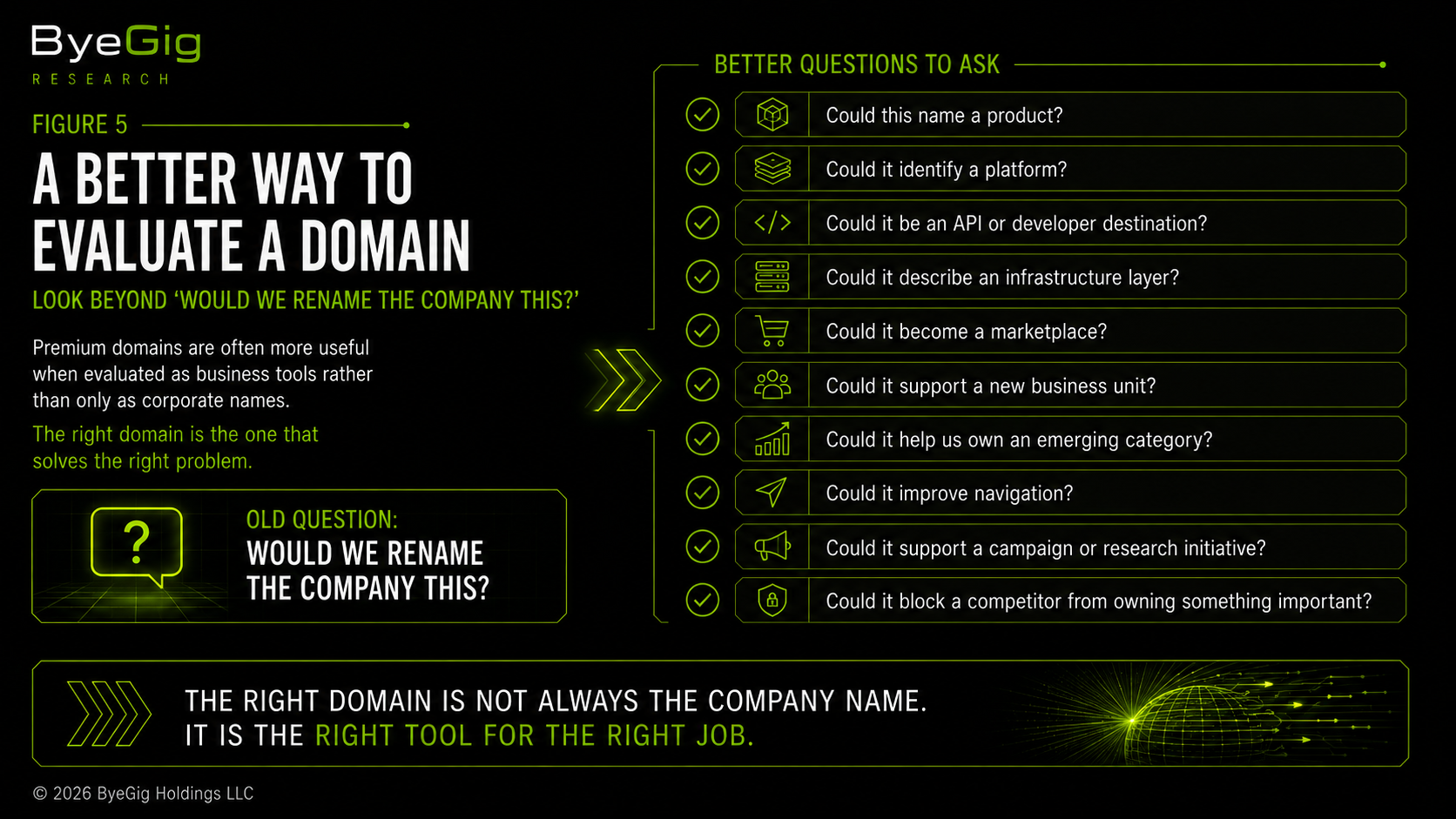
This Is How We Think About ByeGig
This broader view of domains is central to what we are building at ByeGig.
We are not simply collecting possible company names.
We are building a portfolio of digital assets around technologies, industries, infrastructure layers and economic systems that we believe are likely to become more important.
Some ByeGig domains may eventually become company brands. Others may become products, platforms, marketplaces, developer environments, technical infrastructure, business units or research initiatives. Some may simply redirect customers into a much larger corporate website. Others may be acquired because a company decides the strategic value of controlling the name is greater than the cost of buying it.
There will probably also be uses we cannot predict today.
That is part of what makes domains interesting assets.
The value of a good domain is not that it has exactly one obvious use.
It is that the right buyer may see a use that fits what it is building at exactly the right time.
The domain is not always the business.
Sometimes it is the product. Sometimes it is the infrastructure. Sometimes it is the entrance. Sometimes it is the category. Sometimes it is the land underneath something that has not been built yet.
That is the part of the domain market I think far more people need to understand.
ByeGig
