
Before Markets Exist, Someone Must Name Them
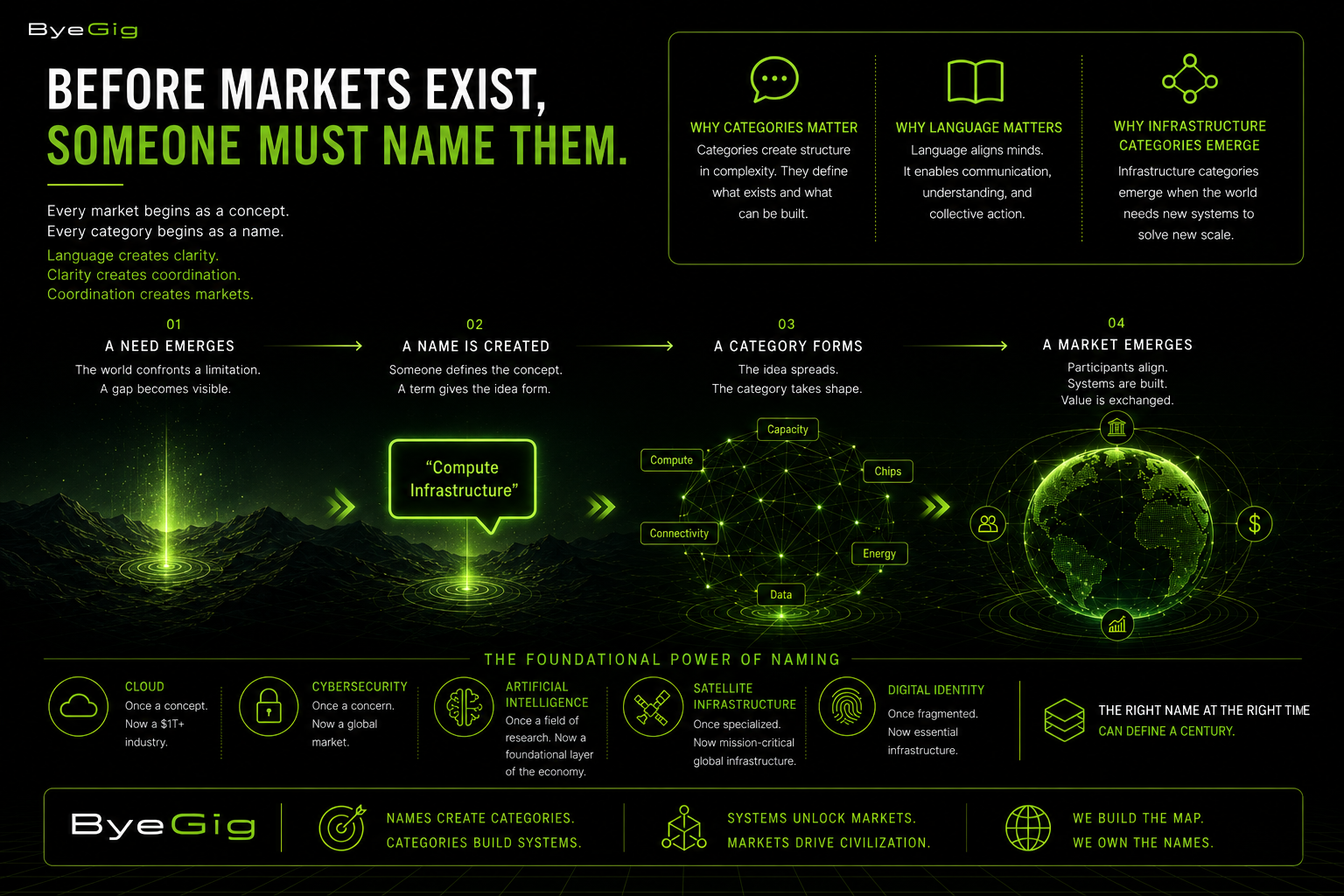
The Hidden Role of Language in Building New Markets, Institutions, and Economies
Every generation has a tendency to believe that the categories surrounding it have always existed.
Cloud computing feels permanent. Cybersecurity feels permanent. Social media feels permanent. Digital payments feel permanent. Venture capital, data centers, software-as-a-service, e-commerce, online marketplaces, autonomous vehicles—today these concepts are so familiar that it is difficult to imagine a world in which they lacked clear definitions, dedicated institutions, specialized investors, industry conferences, regulatory frameworks, trade publications, and billion-dollar companies built around them.
Yet none of these categories appeared fully formed.
Before there were cloud infrastructure companies, there were simply technologists discussing the possibility that computing resources might eventually be delivered as a utility. Before cybersecurity became a global industry, there were only scattered concerns about protecting increasingly important digital systems. Before e-commerce became a dominant force in retail, there were merely a handful of entrepreneurs attempting to convince consumers that purchasing products through a web browser might one day feel normal.
History often remembers categories as inevitable. Living through their formation feels very different.
The categories that shape economies are almost always uncertain in their earliest stages. Their boundaries are unclear. Their commercial potential is debated. Their terminology remains unsettled. Different participants use different language to describe similar concepts. Investors struggle to determine whether a category is real or merely fashionable. Operators struggle to understand where one category ends and another begins.
Then, gradually, a process begins.
Language stabilizes.
Institutions emerge.
Capital accumulates.
Infrastructure develops.
What was once a collection of disconnected ideas becomes a recognizable category.
And eventually that category becomes so familiar that future generations assume it always existed.
This process is one of the least discussed but most important aspects of technological and economic transformation. Entire industries often emerge only after societies develop a shared vocabulary for discussing them. The category itself becomes a coordination mechanism. Entrepreneurs can build within it. Investors can allocate capital toward it. Policymakers can regulate it. Researchers can study it. Customers can understand it.
Without language, categories struggle to form. Without categories, infrastructure struggles to scale.
That observation sits at the center of everything ByeGig does.
Most people who encounter the portfolio for the first time assume they are looking at a collection of domains. In a purely technical sense, that is true. But it misses the underlying idea entirely. The portfolio was never assembled around the belief that domain names themselves are inherently valuable. It was assembled around a different question: if several of the most important technological transitions of our lifetime continue unfolding, what entirely new categories might emerge around them?
That question sounds simple. In practice, it leads to a very different way of looking at the world.
Most investors search for companies. Most journalists search for stories. Most entrepreneurs search for products. Most analysts search for trends. All of these approaches are reasonable, but they share a common characteristic. They focus attention on things that already exist.
Categories often emerge before companies dominate them.
Infrastructure often emerges before categories become obvious.
The most consequential shifts are frequently visible only as weak signals long before they become industries.
The internet provides a useful example. During the late 1990s and early 2000s, much of the public conversation revolved around websites. Websites were visible. They were easy to understand. They generated headlines. Yet from the perspective of long-term value creation, many of the most important developments were occurring beneath the surface. Data centers, fiber networks, payment infrastructure, content delivery systems, cloud architecture, and digital identity frameworks were quietly being built while public attention focused elsewhere.
The same pattern appears repeatedly throughout economic history.
Railroads were never really about trains. They were about transportation infrastructure, logistics networks, capital formation, industrial expansion, and geographic integration. Electricity was never simply about power generation. It became the foundation upon which entirely new industrial systems were constructed. The automobile was never merely a vehicle. It triggered the creation of roads, fuel distribution systems, insurance markets, financing mechanisms, maintenance networks, logistics infrastructure, and suburban development patterns that collectively transformed society.
Technologies introduce possibilities.
Infrastructure determines whether those possibilities scale.
This distinction may be especially important today because several major technological transitions appear to be converging simultaneously.
Artificial intelligence is transforming the economics of computation.
Robotics is moving beyond controlled industrial environments and into increasingly general-purpose applications.
Financial systems are becoming more automated, programmable, and software-defined.
Governments are beginning to view computational capacity as a strategic national resource.
Orbital infrastructure is evolving from scientific experimentation into commercial and operational systems.
Identity, authentication, and verification are becoming increasingly important as synthetic content grows more sophisticated.
Each of these developments receives attention individually. Viewed together, they suggest something larger may be taking shape.
The world may be entering one of the most significant infrastructure buildout cycles since the early internet era.
That statement is easy to underestimate because infrastructure rarely captures public imagination. Infrastructure is not glamorous. Infrastructure generally operates in the background. People notice applications. They notice products. They notice breakthroughs. They rarely notice the systems that make those breakthroughs useful.
Yet the systems often matter more.
Artificial intelligence provides an especially revealing example. Most public discussion focuses on models. Which model performs better. Which company released a new capability. Which benchmark was surpassed. These developments matter, but they may not ultimately represent the most important story. Beneath every model sits an extraordinary amount of physical infrastructure. Data centers, semiconductor manufacturing, power generation, transmission networks, cooling systems, fiber connectivity, and computational resources are all becoming increasingly important.
As demand grows, entirely new coordination challenges emerge. How should computational resources be allocated? How should they be priced? How should access be governed? What happens when computational capacity becomes strategically important enough that governments begin treating it like energy, transportation, or communications infrastructure?
Questions like these are not merely technological. They are institutional.
And institutional questions tend to create categories.
The history of infrastructure suggests that whenever a resource becomes sufficiently valuable, societies build increasingly sophisticated mechanisms for allocating, governing, and coordinating it. Energy gave rise to energy markets. Commodities gave rise to commodity exchanges. Financial assets gave rise to capital markets. Transportation systems gave rise to logistics networks.
If computational capacity becomes one of the defining resources of the twenty-first century, it is difficult to imagine a future in which similarly sophisticated systems do not emerge around it.
The names of those systems remain uncertain.
The categories remain uncertain.
That uncertainty is precisely what makes them interesting.
ByeGig
