
Building the Infrastructure for What’s Next
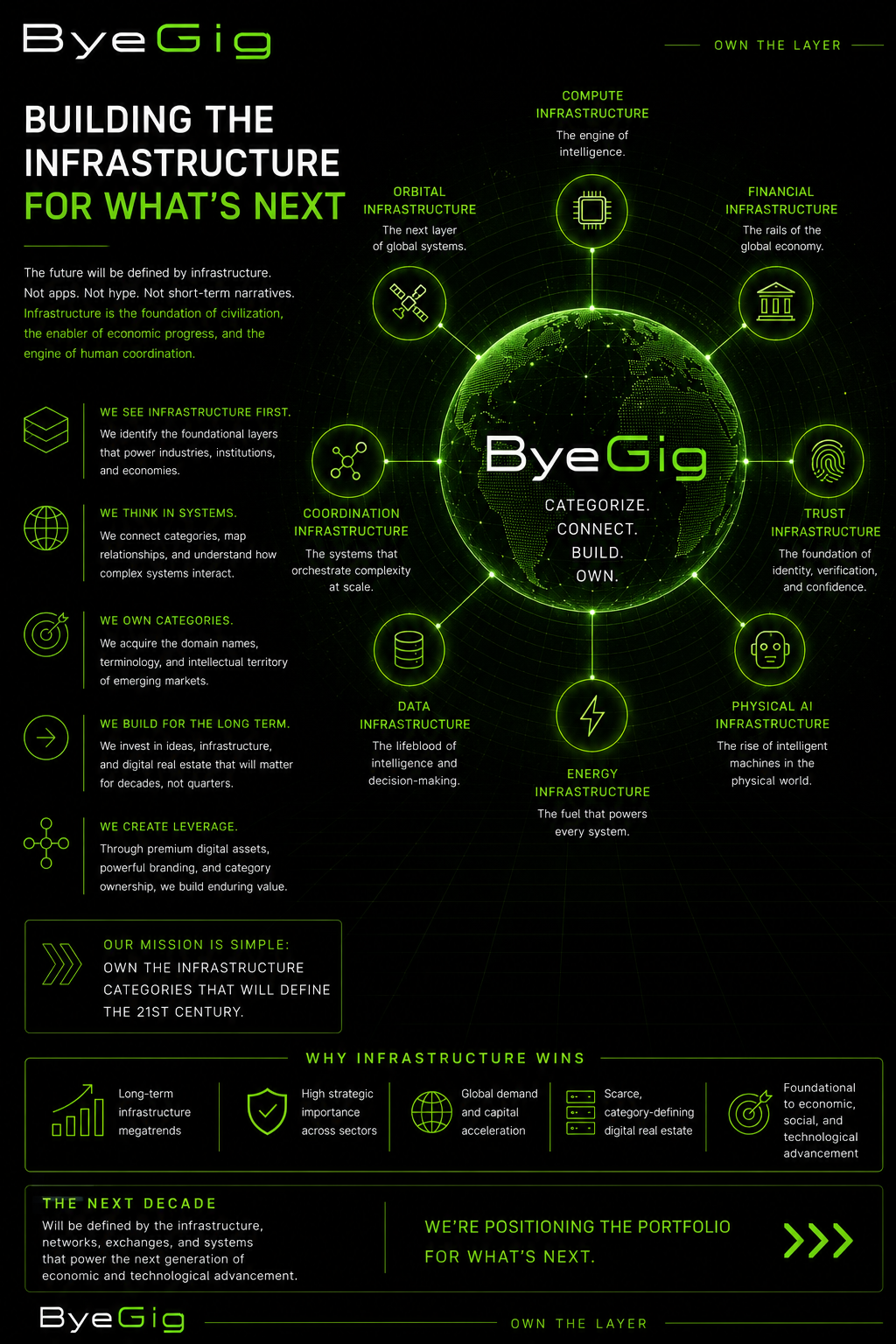
The Foundations of a World That Does Not Yet Exist
Every generation inherits infrastructure built by those who came before it.
We drive on roads we did not construct. We communicate through networks we did not build. We move capital through financial systems designed decades before most of us were born. We consume electricity generated by infrastructure that spans continents. We rely upon institutions, markets, logistics systems, communications networks, and technologies that represent the accumulated work of countless individuals across generations.
Infrastructure is one of humanity’s most powerful forces because it compounds.
Once built, it becomes a platform upon which future growth occurs. It expands what societies are capable of achieving. It lowers barriers, reduces friction, and creates opportunities that would otherwise be impossible.
Most people rarely think about infrastructure because successful infrastructure becomes invisible. We notice products. We notice companies. We notice technologies. We rarely notice the systems quietly enabling them.
Yet history suggests that the greatest periods of economic and societal transformation occur when entirely new infrastructure layers emerge.
Railroads did not simply improve transportation. They transformed trade, manufacturing, migration, and economic development. Electrical grids did not merely provide power. They reshaped industry, cities, communications, and daily life. The internet did not simply connect computers. It fundamentally changed commerce, media, education, finance, and global coordination.
The pattern repeats throughout history.
The most important developments are often not the technologies themselves but the infrastructure built around them.
Today, we may be entering another such period.
Artificial intelligence is expanding rapidly. Compute is becoming strategically important. Physical AI is moving from laboratories into real-world environments. Financial systems are becoming increasingly software-defined. Trust and verification are emerging as critical challenges in a world of synthetic content. Orbital systems are evolving from specialized technologies into operational infrastructure supporting communications, navigation, and global connectivity.
Each of these developments is significant on its own.
Together, they suggest something much larger.
They suggest that new infrastructure layers are being constructed beneath modern civilization.
The implications extend far beyond technology.
The systems being built today may influence how future economies allocate resources. They may influence how governments operate, how businesses coordinate activity, how capital flows, how people work, and how societies organize themselves. Entire industries that do not yet exist may emerge from infrastructure currently in its earliest stages.
History offers countless examples of this phenomenon.
Few people could fully appreciate the implications of railroads before national rail networks existed. Few could foresee the impact of electrification before power grids expanded across cities and regions. Few understood what the internet would ultimately become during its earliest years.
The future is difficult to predict because infrastructure creates second- and third-order effects that are often invisible at the beginning.
New infrastructure enables new behaviors.
New behaviors create new markets.
New markets create new institutions.
New institutions reshape economies.
The cycle repeats.
This is why some of the most important opportunities often emerge long before they become obvious.
By the time a category is universally understood, much of the foundational work has already been completed. The infrastructure has been built. The standards have been established. The networks have formed. The institutions have emerged.
The greatest uncertainty exists earlier, when categories remain undefined and the future remains unclear.
That is where we find ourselves today.
The coming decade may bring changes that are difficult to fully anticipate. Entirely new forms of work may emerge. Economic systems may become increasingly software-defined. Autonomous systems may become commonplace. Compute may become a strategic resource. Trust may become infrastructure. Orbital networks may become as essential to modern economies as telecommunications networks are today.
Some developments will exceed expectations.
Others will fail.
Most will evolve in ways nobody currently predicts.
What seems increasingly likely, however, is that many of the most important changes will occur beneath the surface.
Not in the products that capture headlines.
Not in the applications attracting attention.
But in the systems quietly being constructed beneath them.
Those systems are the infrastructure for what comes next.
And history suggests that infrastructure is where some of the most important stories begin.
ByeGig
