
Infrastructure Thesis Series: Physical AI
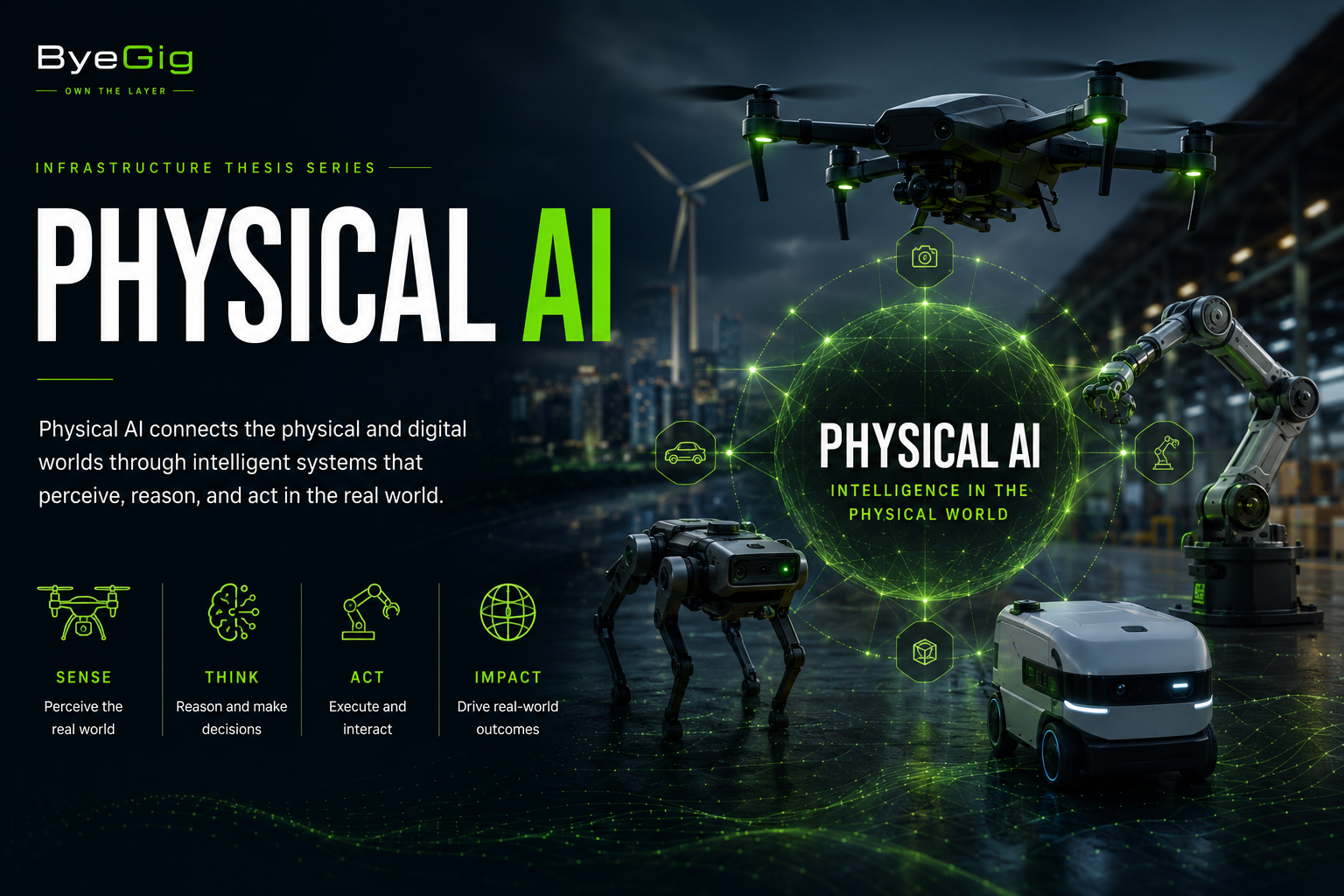
The next major expansion of AI will move beyond screens.
It will enter the physical world.
This transition fundamentally changes the infrastructure required to support artificial intelligence systems.
Software-only AI systems primarily operate inside cloud environments and digital workflows.
Physical AI systems operate across: • factories • warehouses • transportation systems • logistics networks • construction sites • hospitals • retail environments • energy infrastructure • defense systems • autonomous vehicle ecosystems
The moment AI begins interacting with physical environments, entirely new operational requirements emerge.
These systems require: • real-world coordination • sensor fusion • robotics orchestration • edge compute infrastructure • low-latency inference • autonomous routing systems • machine telemetry • charging infrastructure • fleet coordination • environmental mapping • operational safety systems
Physical AI is not simply a software category.
It is an infrastructure category.
Humanoid robotics illustrates this shift clearly.
Once humanoids move from demonstration to deployment, organizations will need infrastructure capable of coordinating large populations of machines operating continuously across real-world environments.
That creates demand for: • humanoid runtime systems • robotics control layers • autonomous fleet management • robot charging networks • industrial orchestration platforms • machine coordination infrastructure • embodied AI operating systems
The infrastructure challenge becomes exponentially larger when systems must operate reliably in dynamic physical environments rather than predictable software environments.
This may become one of the defining infrastructure transitions of the next decade.
The companies building physical AI systems will likely require entirely new categories of: • operational middleware • industrial coordination systems • robotics networking layers • machine orchestration platforms • autonomous infrastructure fabrics
The market opportunity extends far beyond robotics manufacturers themselves.
Large ecosystem value may emerge around the infrastructure layers coordinating physical AI deployment at scale.
Historically, physical infrastructure revolutions create long-duration enterprise ecosystems: railroads, telecommunications, cloud computing, mobile networks, logistics systems.
Physical AI may follow the same pattern.
The eventual winners may not simply build the best robots.
They may own the infrastructure layers coordinating how millions of autonomous machines operate across the real world.
