
Infrastructure Thesis Series: AI Infrastructure
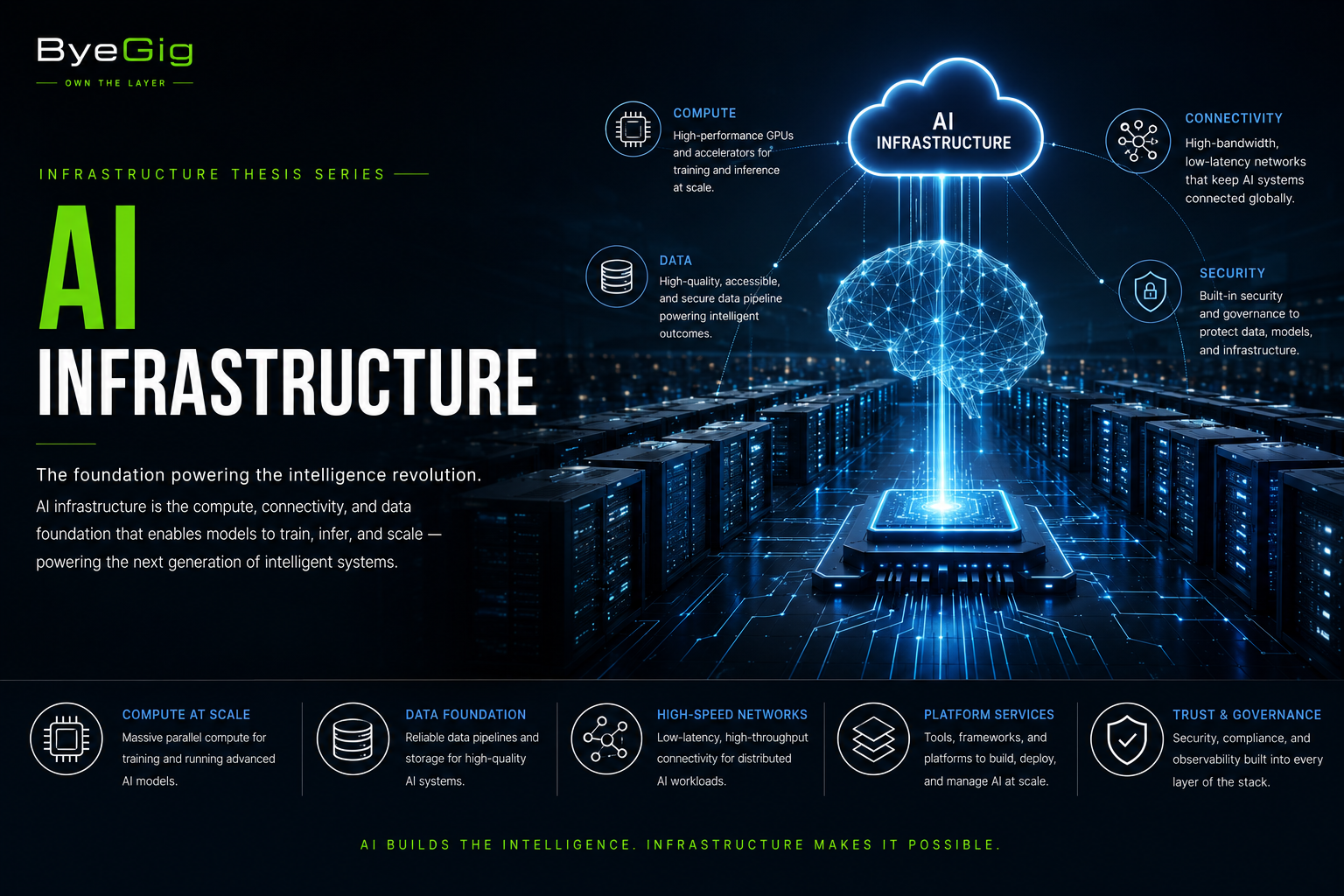
Technology shifts do not just create new products.
They create entirely new infrastructure layers.
As AI systems become autonomous, persistent, multimodal, and embedded into real-world operations, new categories are emerging around orchestration, coordination, security, compute allocation, industrial intelligence, and machine autonomy.
Most of these categories do not yet have mature language around them.
That matters.
Historically, the companies that define the terminology often help define the market itself.
The ByeGig Infrastructure Thesis Series explores the infrastructure layers likely to emerge across AI, defense, robotics, compute, finance, energy, and industrial systems over the next decade.
This series is not focused on hype cycles or consumer applications.
It is focused on the underlying operational architecture powering the next generation of autonomous systems and global infrastructure networks.
The first thesis:
AI Infrastructure
The next phase of artificial intelligence will not be defined by models alone.
It will be defined by infrastructure.
The market narrative around AI has largely focused on model capability: larger models, better reasoning, multimodal systems, agentic behavior, and inference performance.
But as adoption accelerates, the limiting factor increasingly becomes the operational layer beneath the models themselves.
AI systems require: • compute orchestration • inference routing • memory coordination • data pipelines • runtime management • security layers • agent governance • workload allocation • telemetry • distributed execution systems
This is infrastructure.
The modern AI stack is beginning to resemble earlier infrastructure revolutions: cloud computing, networking, virtualization, cybersecurity, and financial exchanges.
As AI workloads become persistent and autonomous, infrastructure complexity increases dramatically.
Organizations are no longer managing isolated software applications.
They are beginning to manage continuously operating AI systems interacting across: • enterprise environments • industrial operations • robotics • logistics networks • cybersecurity systems • defense systems • financial markets • cloud infrastructure
This creates demand for entirely new operational categories.
Examples include: • AI infrastructure exchanges • inference networks • compute allocation systems • orchestration runtimes • agent coordination layers • AI control planes • distributed inference fabrics • autonomous workload routing systems
The terminology itself is becoming strategically important.
Historically, category-defining infrastructure terms become major enterprise markets: operating systems, cloud platforms, application servers, API gateways, data warehouses, content delivery networks, cybersecurity platforms.
AI infrastructure appears to be following the same pattern.
The next major AI companies may not simply build better models.
They may control the infrastructure layers coordinating how AI systems operate at scale.
That distinction matters.
Infrastructure layers often become the highest-moat segments of technology ecosystems because they sit between systems, workloads, users, and operations.
As AI adoption expands globally, infrastructure coordination becomes increasingly valuable.
The market may ultimately evolve toward: • AI compute marketplaces • autonomous inference exchanges • sovereign compute grids • distributed AI coordination systems • enterprise agent infrastructure • AI operational fabrics • machine-scale orchestration layers
The AI era is no longer just about intelligence.
It is increasingly about infrastructure capable of managing intelligence at planetary scale.
