
Memory Is Becoming Infrastructure
The next AI bottleneck will not be solved by buying more GPUs
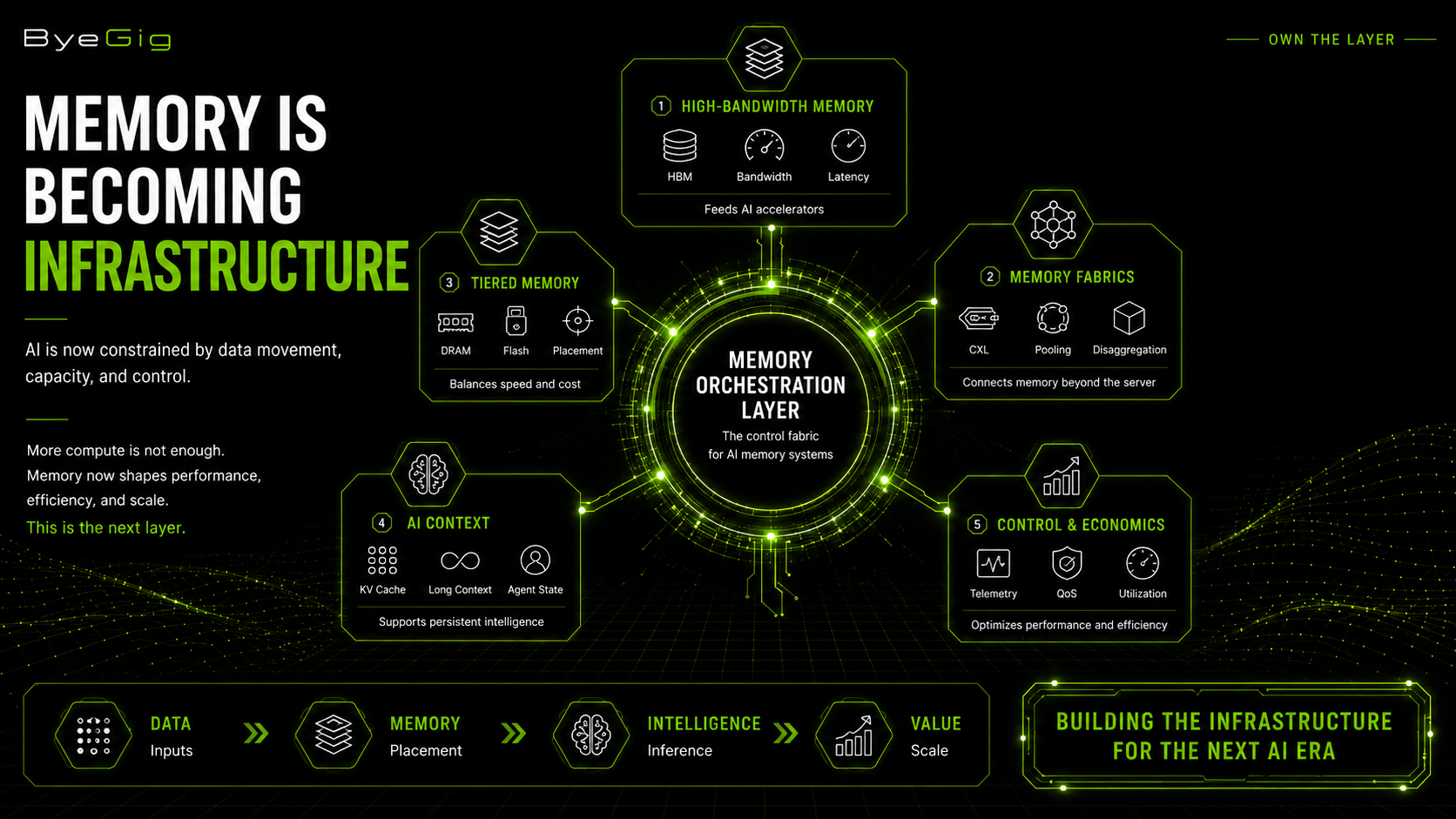
For most of the artificial intelligence boom, compute has served as the industry’s dominant unit of attention.
Companies count GPUs. Governments announce sovereign compute programs. Cloud providers compete over accelerator availability. Startups raise capital based partly on their ability to secure access to processing capacity.
That focus was justified. Advanced AI systems require enormous amounts of computation, and the most capable accelerators remain expensive, difficult to manufacture, and concentrated among a small number of suppliers.
But compute is only useful when processors can access the right information quickly enough.
A powerful accelerator waiting for data is not fully productive infrastructure. It is an expensive machine stalled by another part of the system.
That is why the next phase of AI infrastructure will increasingly be defined by memory: how much is available, how quickly it can be accessed, where it is located, how efficiently it is allocated, and whether it can be shared across processors, servers, and entire computing environments.
Memory is no longer merely a component inside a machine.
It is becoming an infrastructure layer.
The memory wall
Modern processors can perform calculations much faster than conventional memory systems can deliver the information required for those calculations.
This imbalance is often described as the memory wall.
The problem becomes especially important in artificial intelligence because large models continuously move enormous quantities of parameters, intermediate results, context, and cached information between memory and processors.
During training, accelerators must repeatedly access model weights and other data across large clusters. During inference, the system must load model parameters and maintain growing stores of contextual information as users submit longer prompts, generate more tokens, and interact with persistent AI agents.
The processor may be capable of performing the next operation, but it cannot proceed until the necessary data arrives.
This means that AI performance is determined not only by raw computing power, but also by:
Memory capacity
Memory bandwidth
Memory latency
Data-movement efficiency
Memory placement
Software coordination
Power consumption
The availability of advanced packaging
The industry has responded by placing high-bandwidth memory, commonly known as HBM, close to advanced processors.
Instead of relying entirely on traditional memory modules located farther from the processor, HBM stacks memory vertically and connects it through extremely wide interfaces. The result is dramatically greater bandwidth within a compact footprint.
The HBM4 standard supports bandwidth of up to approximately two terabytes per second per stack, illustrating how aggressively the industry is redesigning memory around AI and high-performance computing.
HBM has therefore become one of the most strategically important components in the AI supply chain.
But it is also expensive, difficult to manufacture, packaging-intensive, and limited in capacity.
That creates a larger question:
What happens when the fastest memory is too scarce and costly to hold everything an AI system needs?
The answer is not one replacement technology. It is an emerging hierarchy of memory resources, connected and managed as infrastructure.
From memory chips to memory systems
The conventional view of memory is simple.
A server has a certain quantity of memory installed inside it. That memory belongs to the machine. Applications use it until the machine reaches its limits. Expanding capacity generally means adding modules, replacing hardware, or purchasing another server.
AI infrastructure is pushing the industry away from that fixed model.
Memory is beginning to look more like a distributed resource that can be expanded, pooled, tiered, monitored, assigned, and reclaimed.
The emerging architecture may contain several layers:
Extremely fast HBM located beside an accelerator
Conventional DRAM attached to a processor
Expandable memory connected through high-speed interconnects
Shared memory pools available to multiple machines
Flash-based capacity used for colder or less frequently accessed information
Storage systems holding model weights, datasets, checkpoints, and long-term context
The challenge is deciding what data belongs in each layer and moving it before performance suffers.
The most valuable memory is not always the fastest memory. It is the right memory, positioned at the right place, at the right time, for the right workload.
That turns memory management into an orchestration problem.
CXL changes the architecture
One of the most important technologies in this transition is Compute Express Link, or CXL.
CXL provides a high-speed connection between processors, accelerators, memory devices, and other infrastructure components. It allows systems to attach additional memory without treating every resource as permanently confined to a single server.
The CXL Consortium’s current CXL 4.0 specification doubles bandwidth to 128 gigatransfers per second and expands support for bundled ports and memory reliability features.
The strategic importance of CXL is not limited to faster connections.
It creates the possibility of composable memory infrastructure.
Instead of building every server with enough local memory to handle its theoretical maximum workload, operators may maintain pools of capacity that can be assigned where needed. Underused memory does not have to remain trapped inside one machine while another machine runs short.
This matters because data centers frequently contain substantial amounts of stranded memory: installed capacity that is technically available but cannot easily be redirected to another system.
Recent research examining cloud environments estimates that 25% to 35% of installed DRAM may be stranded in production clusters.
A memory pool could turn that unused capacity into an accessible resource.
That is conceptually similar to transformations already seen elsewhere in computing.
Virtualization separated applications from individual physical servers. Cloud platforms turned compute capacity into an on-demand service. Software-defined networking separated network control from fixed hardware configurations.
Memory is beginning to undergo its own form of abstraction.
Memory tiering becomes an operating function
Not every piece of data requires the same performance.
Frequently accessed information may need to remain in HBM or local DRAM. Less active information can be placed in slower but less expensive memory. Cold data may move into flash storage until the system expects to need it again.
This process is known as memory tiering.
The concept is straightforward. The execution is difficult.
A tiering system must continuously determine:
Which data is active
Which data is likely to become active
Which workloads deserve priority
When information should be promoted into faster memory
When information should be demoted into a lower-cost tier
How to prevent constant movement between tiers
How to isolate competing tenants
How to measure performance degradation
How to enforce service-level requirements
These are not merely hardware decisions. They require software, policy, telemetry, and control.
In June 2026, AMD acquired MEXT, a company developing technology that allows flash memory to appear more like DRAM to applications. MEXT’s system predicts which information will be needed and moves it between flash and DRAM, demonstrating how strategically important software-controlled memory tiering is becoming.
This acquisition is significant because it shows that the competitive frontier is expanding beyond producing faster chips.
The future system must intelligently manage a hierarchy of resources.
A memory device provides capacity.
A memory platform decides how that capacity should be used.
AI agents increase the pressure
The shift toward AI agents will intensify the memory problem.
A conventional chatbot may process a prompt, produce an answer, and release much of its temporary state.
A persistent agent may operate for hours, days, or longer. It may maintain a history of interactions, access documents, monitor external systems, coordinate with other agents, and preserve state across many tasks.
Every additional layer of context creates a memory requirement.
Long-context models also produce large key-value caches, commonly called KV caches, which store information used during inference. As context windows and concurrent user sessions grow, these caches can consume enormous amounts of memory.
The industry can respond in several ways:
Compress the cache
Remove less useful context
Move inactive context into slower memory
Share cached information across requests
Distribute memory across multiple systems
Create specialized context-storage infrastructure
Research published in June 2026 proposed using CXL-based hybrid memory to provide terabyte-scale, byte-addressable capacity for large inference workloads. In its evaluation, the system improved throughput by as much as 35.7% by expanding the memory available for model weights and KV caches beyond the limits of host memory.
The details of any single experimental architecture may change.
The direction is more durable.
As AI applications become persistent, contextual, multimodal, and agentic, memory will increasingly determine how many users a system can support, how long an agent can maintain state, how large a model can be served, and how economically inference can operate.
Memory is also an energy problem
Moving data consumes energy.
In many computing workloads, transporting information between memory and processors can require as much attention as performing the underlying calculations.
This means memory architecture affects not only speed but also the power economics of AI.
Data centers already face limits involving grid capacity, interconnection delays, backup generation, cooling, and electricity pricing. Adding processors without improving memory efficiency may increase energy use without producing a proportional increase in useful work.
The infrastructure question is therefore not simply:
How much compute has been installed?
It is:
How efficiently can the entire system feed that compute?
Better memory placement can reduce unnecessary transfers. Shared capacity can reduce overprovisioning. Tiering can reserve expensive high-performance memory for the workloads that genuinely require it. Processing-in-memory and near-memory computing may eventually reduce the distance that data must travel.
Memory design is therefore becoming inseparable from energy design.
A more efficient memory system can improve the output of existing compute infrastructure without requiring an equivalent increase in accelerators or electricity.
Scarcity spreads beyond AI
The demand for AI memory does not remain contained within AI.
The same manufacturers, fabrication capacity, packaging facilities, materials, and capital equipment may also support conventional DRAM and other semiconductor products used in automobiles, smartphones, industrial systems, telecommunications equipment, medical devices, and consumer electronics.
When manufacturers devote more resources to HBM, other markets can experience tighter supply or higher prices.
Industry groups have already warned that AI data-center demand is affecting broader memory availability and creating supply-chain risks across other sectors.
This changes the geopolitical importance of memory production.
Governments increasingly understand that control over leading-edge logic chips matters. The same strategic analysis will expand to include:
HBM production
Advanced packaging
Memory substrates
Interposers
Testing capacity
Memory controllers
CXL switching
Photonic interconnects
Memory-management software
Specialized materials
Manufacturing equipment
A nation may possess large quantities of general-purpose compute yet still face constraints if it lacks access to the memory and packaging technologies necessary to operate that compute efficiently.
Sovereign AI infrastructure will eventually require a sovereign memory strategy.
New infrastructure categories will emerge
When a resource becomes scarce, expensive, measurable, and shareable, markets begin forming around it.
Compute followed this pattern.
Processing capacity was once purchased primarily as part of a physical machine. It later became virtualized, metered, rented, exchanged, reserved, and traded through cloud and infrastructure platforms.
Memory may follow a related path.
A mature memory-infrastructure ecosystem could include:
Memory fabrics
Systems connecting processors and memory across multiple devices or racks.
Memory pooling
Shared capacity allocated dynamically among workloads.
Memory tiering platforms
Software that places information across HBM, DRAM, CXL memory, flash, and storage.
Memory control planes
Management systems that establish policies, priorities, isolation, and service levels.
Memory observability
Tools that show where capacity is located, which applications are consuming it, and where bottlenecks are developing.
Memory marketplaces
Platforms through which capacity is reserved, priced, allocated, or potentially exchanged.
Memory utilities
Large shared memory resources delivered as infrastructure rather than owned by an individual application or server.
Memory security systems
Technologies governing access, encryption, tenancy, and data movement across shared pools.
Memory-aware operating systems
Software capable of managing increasingly complex and distributed memory hierarchies.
These categories will not all mature at the same time.
Some may remain features inside broader infrastructure products. Others may support independent companies. Some terminology will disappear while better language emerges.
But the underlying function will remain necessary.
Someone must decide how memory is organized, assigned, protected, moved, measured, and monetized.
The control plane matters more than the component
The largest long-term opportunity may not belong exclusively to the company producing the memory chip.
Components are essential, but infrastructure value frequently migrates toward the layer that coordinates the components.
The operating system became more strategically important than many individual computer parts. Cloud control planes became more valuable than undifferentiated servers. Network orchestration became essential as infrastructure became distributed.
Memory may develop similarly.
As systems become more complex, operators need a unified way to answer basic questions:
How much memory is available?
What type is it?
Where is it located?
Who is using it?
What does it cost?
Which workload should receive priority?
What happens when capacity becomes constrained?
Can the information be moved without interrupting the application?
Is the shared memory secure?
Is performance meeting contractual requirements?
Recent research into multi-tenant CXL environments emphasizes precisely these control-plane and observability requirements. One 2026 system introduced per-container allocation controls, fairness policies, and detailed monitoring for tiered memory, improving workload performance by as much as 52% over an existing Linux-based approach in production evaluations.
This is the moment when a hardware resource begins turning into a managed system.
And managed systems eventually need names.
Naming the memory layer
The language surrounding AI memory remains unsettled.
Terms including HBM, CXL, pooled memory, disaggregated memory, composable infrastructure, tiered memory, persistent memory, computational memory, and memory fabrics describe overlapping but distinct parts of the emerging architecture.
This uncertainty is not a weakness in the market.
It is evidence that the category is still forming.
Early infrastructure markets are rarely described with perfect consistency. Companies experiment with terminology while technologies converge, business models develop, and buyers learn what they actually need.
The enduring names will likely describe functions rather than individual technical standards.
A standard can be replaced.
A function persists.
The need to tier memory will remain even as the underlying devices change. The need to connect memory will remain even if the preferred interconnect evolves. The need to allocate capacity will remain even if future architectures combine memory and storage in ways that do not fit today’s definitions.
This is why names such as MemoryTiering.com, MemoryFabricNetwork.com, ComputeMemoryNetwork.com, MemoryCapacityMarket.com, and MemoryInfrastructureNetwork.com point toward more than semiconductor components.
They describe potential operating layers.
ByeGig’s interest is not based on predicting that every phrase will become an independent industry category.
The thesis is that memory is moving from a fixed component toward a networked, managed, economically important resource—and that the language used to describe this transition will become increasingly valuable as the market develops.
The next constraint changes the market
Every infrastructure era begins by focusing on its most visible constraint.
During the first phase of the AI buildout, that constraint was accelerators.
The industry responded with enormous investments in GPUs, custom silicon, data centers, cloud capacity, energy generation, and national compute programs.
Those investments do not eliminate constraints.
They move the constraint elsewhere.
More processors require more electricity. More electricity requires more generation and grid infrastructure. More models require more data movement. More agents require more context. More inference requires more bandwidth and memory capacity.
The bottleneck migrates through the system.
Memory is now becoming one of the places where that pressure accumulates.
This does not mean compute becomes unimportant.
It means compute can no longer be evaluated alone.
The winning AI infrastructure will not necessarily belong to the organization with the largest number of accelerators. It may belong to the operator that uses every accelerator more effectively by controlling the flow of data around it.
That requires memory architecture.
It requires memory software.
It requires memory networks.
It requires a memory control plane.
The age of counting GPUs is not ending.
But the age of understanding what keeps them working has begun.
And memory is moving to the center of the system.
ByeGig
