
Why World Models Could Become Strategic Infrastructure
The race to build AI may ultimately become a race to build the most accurate representation of reality.
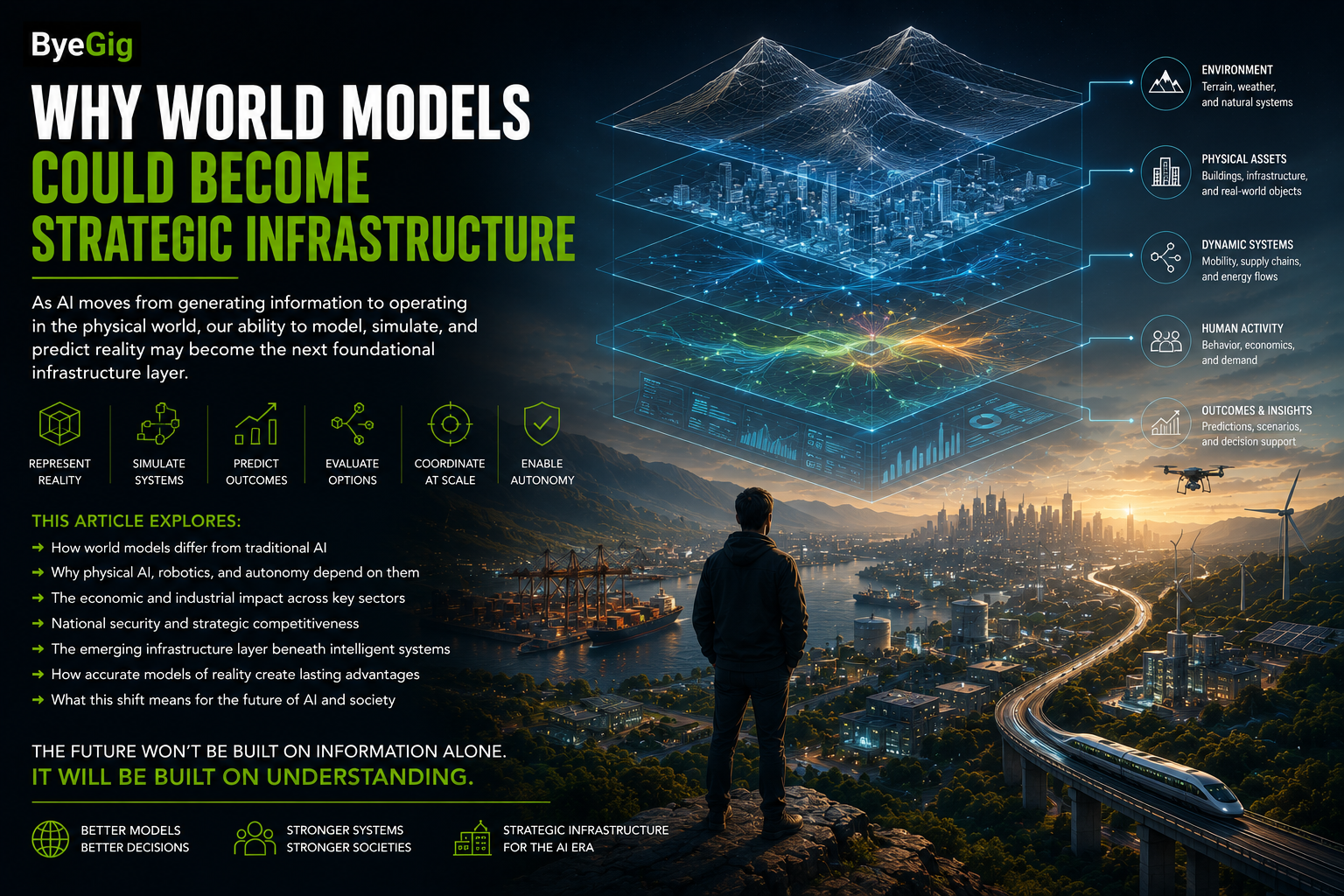
For most of the history of computing, machines have existed primarily as tools for processing information. They stored records, performed calculations, connected people, organized data, and eventually generated content. Even the recent explosion in artificial intelligence has largely occurred within the digital world. AI systems write emails, generate images, summarize reports, answer questions, and produce software code. Their outputs are increasingly impressive, but they remain largely confined to screens.
That may be changing.
The next phase of artificial intelligence appears increasingly focused not on understanding documents, but on understanding reality itself. Across industries, intelligent systems are moving into environments where decisions have physical consequences. Robots are entering factories and warehouses. Autonomous vehicles continue to improve. Drones are becoming central to logistics, infrastructure inspection, agriculture, and defense. AI systems are beginning to coordinate power grids, monitor transportation networks, optimize industrial operations, and assist in managing increasingly complex supply chains. As these systems move beyond generating information and begin interacting directly with the physical world, a new challenge emerges. Machines must understand more than language. They must understand how the world works.
This is where world models become important.
A world model is often described as an internal representation of reality. While that definition may sound technical, the concept itself is remarkably intuitive. Human beings rely on world models constantly. Every time a driver approaches an intersection, they are predicting how other vehicles might behave. Every time an engineer evaluates a structure, they are anticipating how materials will respond to stress. Every time a logistics manager allocates inventory or schedules transportation, they are making assumptions about future events. People continuously construct mental representations of reality and use them to make decisions. In many ways, intelligence itself depends on this ability.
Machines increasingly need the same capability.
The significance of this shift is easy to underestimate because much of today’s AI conversation revolves around language models. Large language models have captured public attention for good reason. They represent one of the most important advances in computing history. Yet language is only one aspect of intelligence. The real world is governed by physics, geography, economics, timing, uncertainty, and countless interconnected systems that rarely present themselves in neat textual form. A robot moving through a warehouse does not simply need to identify objects. It must understand where those objects are likely to move, how they affect possible routes, and what consequences its actions may create several steps into the future. A drone navigating complex airspace must continuously anticipate changing conditions. A logistics platform must evaluate how weather, port congestion, labor shortages, and transportation delays interact. These problems are fundamentally different from predicting the next word in a sentence.
What they require is a model of reality.
This distinction may ultimately become one of the most important developments in artificial intelligence. For decades, software primarily focused on recording and processing information. Databases stored facts. Enterprise systems tracked transactions. Search engines organized knowledge. Today, an entirely new layer appears to be emerging. Rather than simply storing information about the world, future systems may increasingly attempt to simulate the world itself.
Consider how many important decisions are made under conditions of uncertainty. Businesses decide where to invest capital. Governments decide where to build infrastructure. Manufacturers determine production schedules. Utilities balance electricity supply and demand. Defense organizations evaluate threats and allocate resources. In each case, decision makers are trying to understand not only what exists today but what is likely to happen tomorrow. Better predictions create better decisions. Better simulations create better predictions.
This is where world models become strategically valuable.
The organizations capable of building highly accurate representations of physical and economic systems may gain advantages that extend far beyond traditional software. Imagine a platform capable of continuously modeling a global supply chain. Rather than simply reporting inventory levels or transportation schedules, it could estimate future disruptions, identify bottlenecks before they occur, evaluate alternative scenarios, and recommend actions in real time. Imagine an energy system capable of modeling weather, electricity demand, generation capacity, storage availability, transmission constraints, and industrial consumption simultaneously. Imagine a defense system capable of integrating information from satellites, drones, sensors, logistics networks, communications infrastructure, and operational assets into a continuously evolving representation of the battlefield. The value of these systems would not come solely from information. It would come from understanding.
History suggests that technologies capable of improving understanding often become foundational infrastructure. Railroads transformed the movement of goods. Electrical grids transformed the distribution of energy. Telecommunications networks transformed communication. The internet transformed information exchange. Cloud computing transformed access to computing resources. Each infrastructure layer reduced friction and expanded what was possible for the layers built above it.
World models may eventually occupy a similar position.
What makes them particularly interesting is that they operate at a level deeper than many existing software platforms. Search engines organize information about the world. World models attempt to understand the world itself. Mapping platforms represent locations. World models seek to understand how those locations interact. Enterprise software records business activity. World models attempt to predict how business systems will evolve. This difference may seem subtle, but it represents a significant shift in capability.
As artificial intelligence becomes more deeply integrated into physical environments, the need for these representations will likely increase. Humanoid robots, autonomous vehicles, drone fleets, industrial automation systems, smart infrastructure, and intelligent supply chains all require some understanding of reality. They must anticipate future states, reason through uncertainty, and evaluate potential actions before taking them. The more autonomy these systems receive, the more important accurate world models become.
This dynamic may eventually extend beyond companies and into questions of national competitiveness. Over the past decade, governments have increasingly recognized the strategic importance of semiconductors, advanced manufacturing, artificial intelligence, satellite networks, and data centers. These assets are no longer viewed solely through a commercial lens. They are increasingly understood as components of national capability. World models may follow a similar path. A nation with superior models of transportation systems, energy infrastructure, industrial capacity, geographic conditions, and economic activity may possess meaningful advantages in planning, resilience, and decision making. In the twenty-first century, strategic power may depend not only on information but on the ability to simulate complex systems accurately.
This possibility points toward a broader transformation that may already be underway. Much of modern civilization operates through systems that are becoming increasingly interconnected and increasingly difficult for humans to fully comprehend. Supply chains span continents. Financial markets react in milliseconds. Infrastructure networks contain countless dependencies. Energy systems must balance fluctuating demand and generation in real time. As complexity increases, the value of tools that help humans understand interconnected systems increases as well.
World models may become one of the most important of those tools.
Whether they ultimately emerge as standalone platforms, foundational infrastructure layers, or embedded capabilities inside larger systems remains uncertain. What appears increasingly clear, however, is that artificial intelligence is moving beyond language and into reality. As that transition unfolds, the ability to model, simulate, predict, and understand the world may become one of the defining technological capabilities of the coming decades.
If previous eras were defined by access to information, the next era may be defined by understanding how that information interacts across physical and economic systems. The organizations that build the most accurate representations of reality may occupy positions similar to the infrastructure providers that shaped earlier technological revolutions.
The next strategic infrastructure layer may not be visible. It may not be a road, a port, a railway, a power plant, or even a data center.
It may simply be the world’s most accurate model of the world itself.
ByeGig
