
The Grid Is Full. Nuclear Is Coming Back.
Why surging electricity demand, grid constraints, and a new generation of reactors are reshaping the future of energy infrastructure.
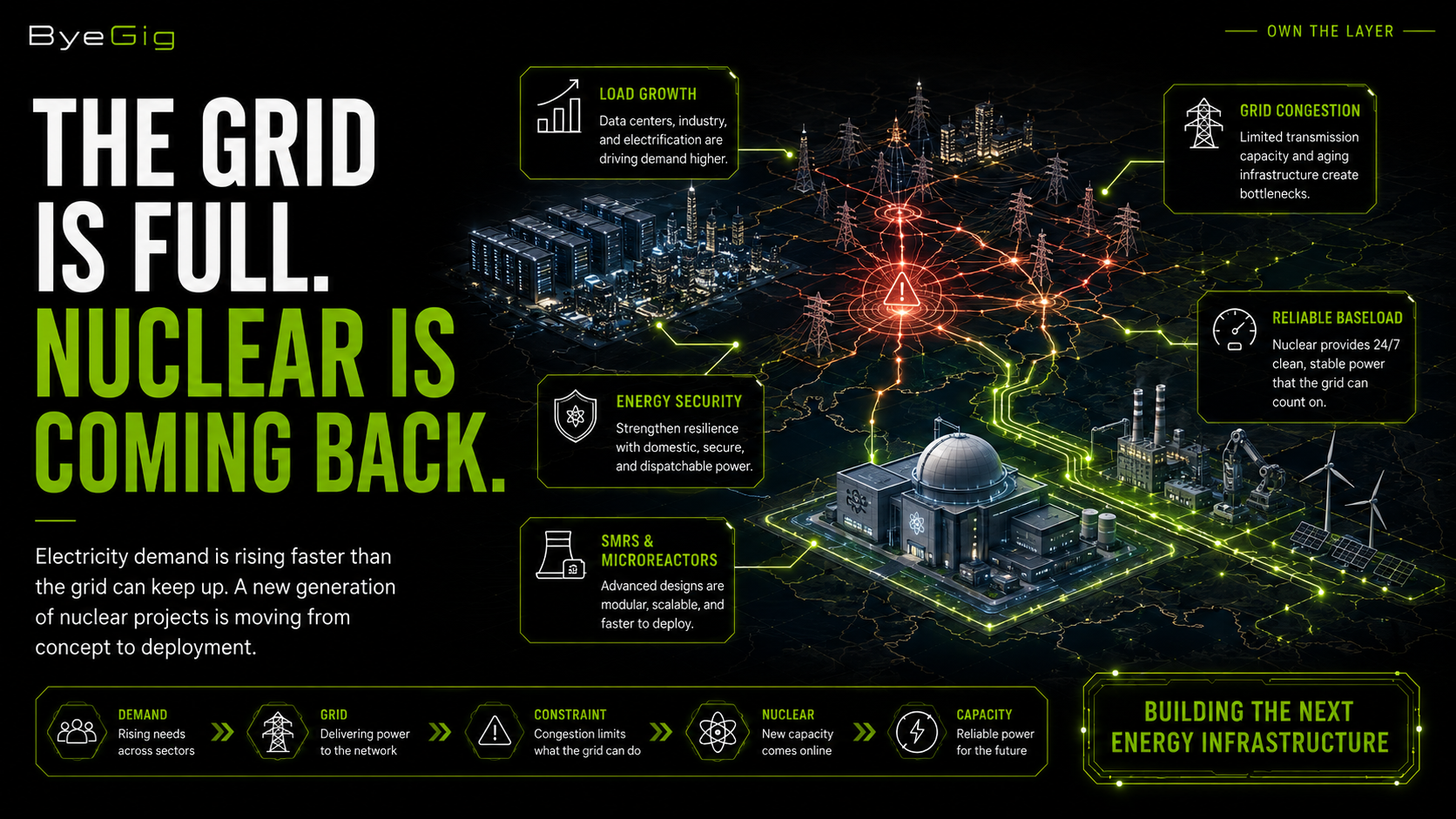
For most of the past two decades, electricity was something the technology economy could largely take for granted. A company could build a data center, expand a factory or add a major new load and assume the grid would be there to support it. That assumption is becoming much less reliable.
Across some of the most economically important parts of the United States, electricity demand is growing faster than generation and transmission infrastructure can be added. Data centers are expanding rapidly, manufacturing investment is increasing, and electrification is adding new sources of demand. New power plants, meanwhile, can take years to permit and build, transmission projects often take even longer, and parts of the existing generation fleet are approaching retirement.
The result is not that the United States is suddenly running out of electricity. The problem is that dependable power is becoming harder to deliver in the right quantity, at the right location and at the right time. That distinction matters, particularly for companies planning projects that require hundreds of megawatts of continuous power.
It also helps explain why nuclear energy is returning to the center of the energy discussion.
The Grid Is Becoming the Bottleneck
The clearest signs are coming from PJM, the electricity market covering 13 states and Washington, D.C., and the largest power grid in the United States. Demand is rising rapidly, with data centers among the principal drivers, while the development of new generation and transmission has struggled to keep pace.
The consequences are already showing up in the market. Transmission congestion costs across PJM reached approximately $6 billion during the first half of 2026, a 43% increase from the previous year. According to PJM’s independent market monitor, high-voltage transmission constraints were a major contributor to the increase in wholesale power costs.
PJM’s capacity market is sending an equally important signal. Its auction for the 2028-2029 delivery year came up approximately 6.8 gigawatts short of its capacity requirement, even with prices reaching the market’s $325 per megawatt-day cap. It was the second consecutive auction in which PJM failed to procure its full capacity requirement.
There is plenty of nuance behind those numbers. Proposed generation exists. Large amounts of capacity remain in development queues. New transmission will eventually relieve some bottlenecks, while storage, renewables and natural gas will add supply.
None of those possibilities solves the immediate problem faced by a company trying to build a 500-megawatt data center today. That company needs dependable electricity at a particular location on a schedule that matches its construction plans.
Power that may exist somewhere else on the grid several years from now is not the same thing.
Electricity Is Becoming Part of the Site
That distinction is beginning to change how companies think about energy.
For years, the major considerations for a data center or industrial development might have included land, labor, transportation, connectivity, taxes and access to customers. Electricity was obviously important, but it was generally treated as a utility service that would be available once the project was ready for it.
Increasingly, power itself is becoming part of the site.
A parcel with a realistic path to hundreds of megawatts of generation can be fundamentally different from a similar parcel without one. Existing generating assets are becoming strategically important. Long-term power contracts can influence investment decisions. Developers are examining onsite generation and other arrangements that reduce their dependence on an already constrained transmission system.
PJM has gone as far as proposing procedures that could require some large electricity users, including data centers, to rely on backup generation during grid emergencies rather than forcing broader outages on residential customers.
That would have been an unusual discussion during the period of relatively flat U.S. electricity demand. Today it reflects a much larger change: a large power consumer can no longer automatically assume that the grid will accommodate whatever load it wants to add.
For AI companies spending billions of dollars on computing infrastructure, manufacturers dependent on continuous operations, and military installations that cannot tolerate prolonged interruptions, certainty of supply can be worth considerably more than simply obtaining the lowest possible electricity price.
That makes technologies capable of providing dependable generation near the point of consumption much more interesting.
Nuclear is one of them.
Nuclear Is Changing at the Right Time
The traditional nuclear industry has always faced a difficult economic problem. Once operating, a nuclear plant can produce enormous quantities of dependable electricity for decades. Building one, however, has historically required a large upfront capital commitment, long construction timelines and complicated regulatory processes.
The industry is now trying to attack that problem from several directions.
Large conventional reactors remain part of the equation. In June, the Department of Energy announced financing for long-lead supply-chain components intended to accelerate the deployment of 10 new large-scale commercial reactors.
At the same time, a different nuclear industry is beginning to develop alongside them. Small modular reactors and microreactors are designed around concepts such as standardized designs, modular construction, factory manufacturing and repeat deployment.
The idea is straightforward even if executing it will be difficult. Instead of treating every new nuclear plant as an enormous custom construction project, developers want at least some reactors to become repeatable industrial products.
That distinction could eventually affect everything from reactor economics to the types of customers capable of using nuclear power.
The Reactor Pipeline Is Starting to Become Real
The developments of the past several months are significant because advanced nuclear is beginning to move beyond announcements and renderings.
In April, the Department of Energy opened the DOME microreactor test bed at Idaho National Laboratory. The facility was built specifically to allow private developers to test and demonstrate advanced reactor technologies and gather the data needed to move their designs toward commercial deployment.
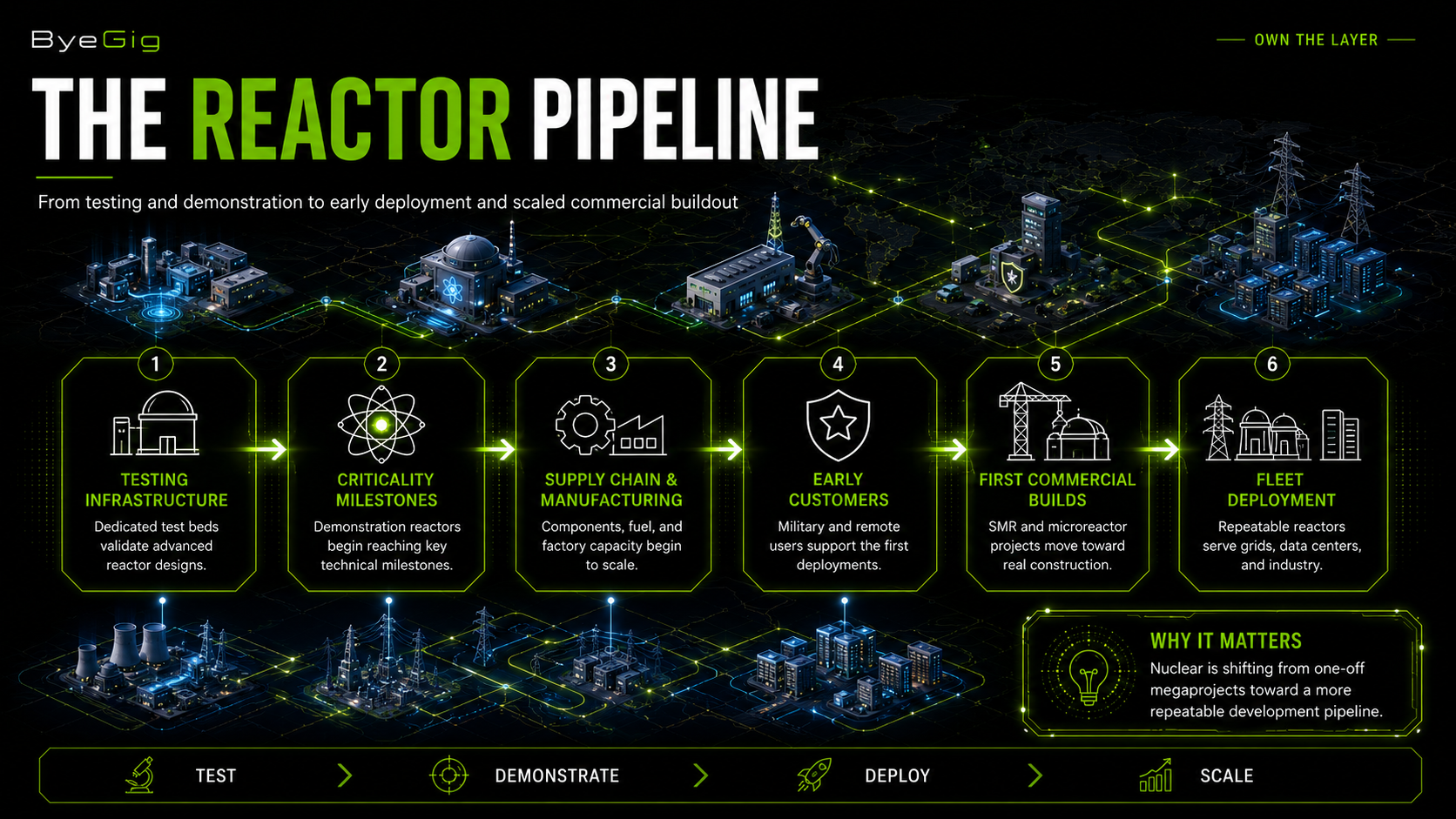
A series of reactor demonstrations followed. Antares Nuclear’s Mark-0 achieved zero-power criticality in June, the first privately developed non-light-water reactor to reach criticality in the United States in more than 40 years. Valar Atomics’ Ward 250 followed later that month, along with Deployable Energy’s Unity reactor. Aalo Atomics’ Aalo-X reached the same milestone in July.
None of those demonstrations guarantees commercial success. Nuclear development has no shortage of companies that have announced ambitious plans without ultimately building operating fleets.
What makes the current period more interesting is that several developers are advancing at once, supported by testing infrastructure, government programs, supply-chain investment and prospective customers.
The U.S. military has become one of the most important of those customers.
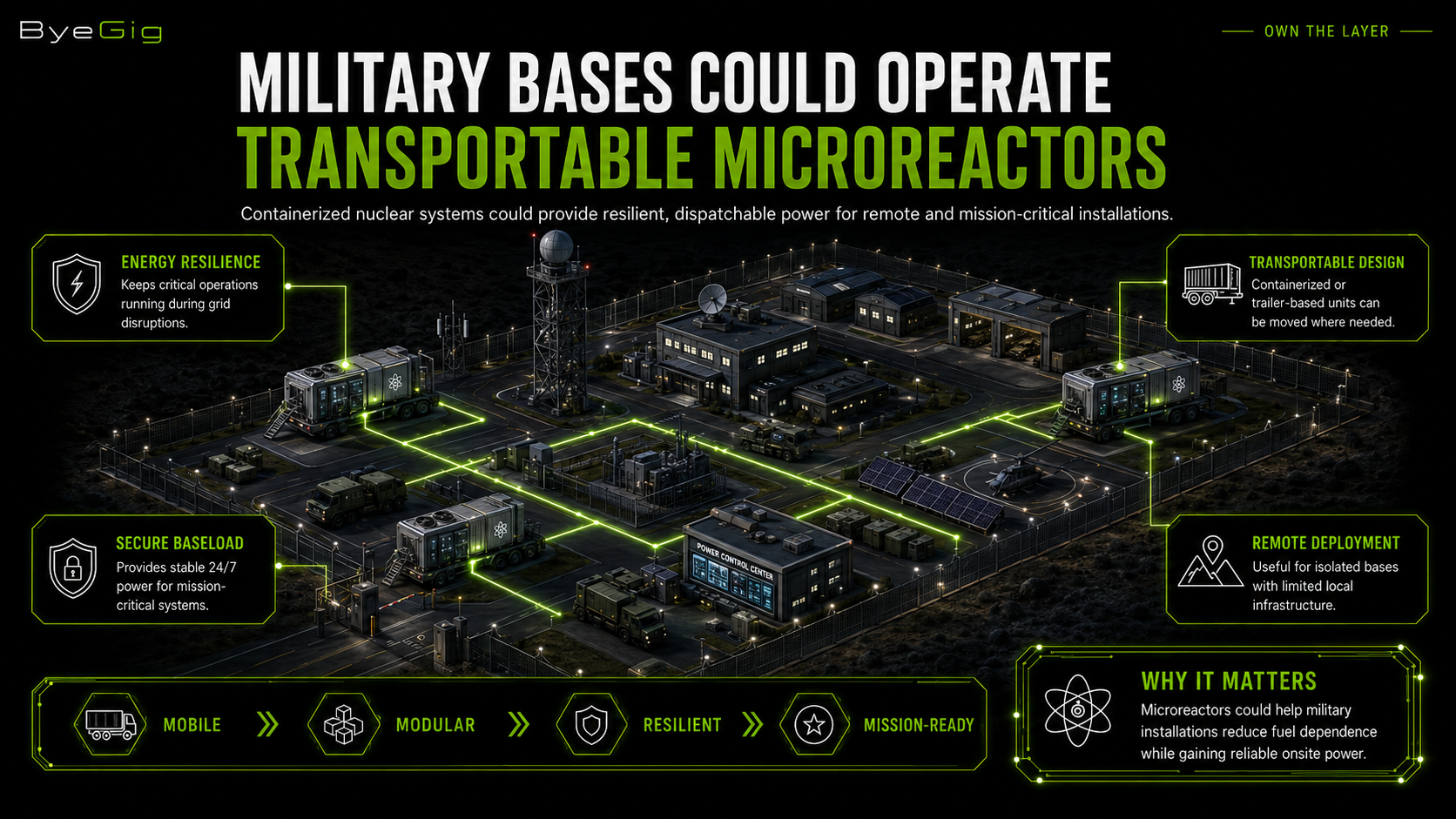
In August, the Army awarded contracts worth as much as $2.2 billion to five companies under Project Janus to develop and deploy microreactors at military bases. The program envisions factory-built reactors capable of producing up to approximately 20 megawatts each, with the goal of establishing commercially viable systems beginning in 2028. The Army also sees potential civilian applications, including data centers.
That is an important development because emerging technologies often need more than technological validation. They need customers willing to support their first deployments.
The military has reasons to value nuclear power that extend beyond the economics of electricity. Energy security, resilience and the ability to operate remote facilities all matter. Those requirements could make military installations natural early adopters of microreactors while manufacturing volume and operational experience begin to accumulate.
Small Modular Nuclear Is Moving Beyond the Laboratory
The new nuclear buildout is not limited to experimental microreactors.
Ontario is constructing the first of four GE Hitachi BWRX-300 small modular reactors at the Darlington nuclear site. The first 300-megawatt unit is expected to enter service in 2029. More than 100 Ontario companies are participating in the project, an important indication of the industrial infrastructure forming around the technology.
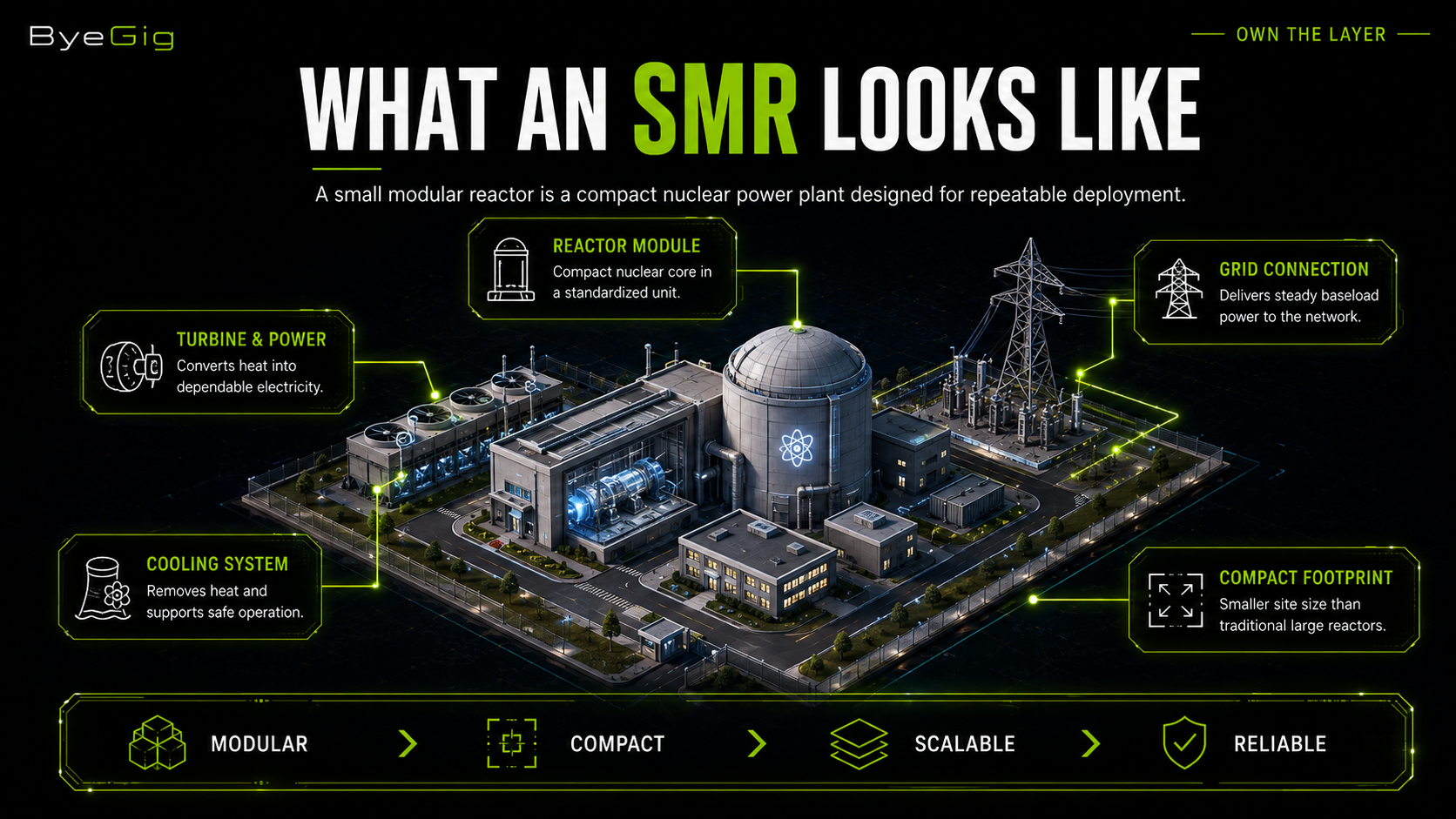
The economics of the first unit will be closely watched. Like many first-of-a-kind projects, it is expensive. The larger opportunity comes from replication. If the second, third and fourth reactors can be built faster and more cheaply because the design, workforce and supply chain already exist, the industry begins to resemble manufacturing rather than one-off construction.
That is ultimately the promise behind modular nuclear.
The first reactor does not have to prove only that the technology works. It also has to establish the process that allows the next reactor to be built more efficiently.
If that process can be repeated across multiple sites and customers, the economics of nuclear development begin to change.
Nuclear May Not Always Look Like a Nuclear Plant
The traditional image of nuclear power is a massive generating station connected to the transmission system and supplying electricity to millions of customers. That model will remain important, particularly as utilities look for large amounts of dependable generation.
The emerging market could be much more varied.
A hyperscale data center campus could eventually secure dedicated nuclear generation. A military installation could operate several transportable microreactors. A remote mining operation could replace large amounts of diesel generation with a small reactor. An industrial complex might use nuclear energy for both electricity and process heat. Utilities could add standardized reactor modules in stages as demand grows instead of making a single multigigawatt commitment.
There are substantial obstacles before this becomes commonplace. First-of-a-kind reactors are expensive. Some advanced designs depend on fuel supply chains that remain underdeveloped. Manufacturing capacity has to grow, regulatory processes still matter, and nuclear construction has a long history of delays and cost overruns that investors have good reason to remember.
Those problems should not be minimized.
What has changed is the other side of the equation.
The Value of Dependable Power Is Rising
For much of the past decade, discussions about electricity generation were dominated by the cost of producing the cheapest incremental megawatt-hour.
That comparison still matters, but it is becoming incomplete.
A megawatt-hour available in the wrong place or at the wrong time cannot necessarily support a new data center. A generation project that takes ten years to reach operation cannot solve a power shortage expected in three. Intermittent generation and dispatchable generation also provide different services to a grid trying to support round-the-clock industrial loads.
As electricity becomes more constrained, the value of reliability, location and speed of deployment rises along with it.
Natural gas will be an important part of meeting that demand. Renewables will continue to grow, storage will become increasingly important, and the United States will need substantially more transmission infrastructure regardless of what happens with nuclear.
Nuclear does not need to replace those technologies to become valuable.
It needs to solve problems that customers are increasingly willing to pay to solve.
Its attraction is straightforward: nuclear can produce large amounts of electricity continuously while requiring relatively little land and very little fuel. If developers can eventually combine those characteristics with standardized designs, factory production and shorter construction schedules, nuclear becomes relevant to a much broader group of electricity buyers.
At that point, its role is no longer limited to decarbonization.
It becomes part of the response to power scarcity.
Power Is Becoming Infrastructure Again
The AI buildout is often discussed as a race for chips, models and data centers. Increasingly, it is also a race for electricity. The same is true for the expansion of domestic manufacturing and other energy-intensive industries.
The grid was built during an era when U.S. electricity demand grew slowly and large customers generally did not appear with requests for hundreds of megawatts at a time. That environment is changing faster than the underlying infrastructure can easily accommodate.
Nuclear is reemerging in the middle of that transition.
The technology still has plenty to prove, particularly on construction cost and deployment speed. But the market into which these new reactors are arriving is very different from the one nuclear developers faced a decade ago.
Electricity is becoming scarce enough in important markets that access to dependable power can influence where billions of dollars of investment goes.
That changes the calculation.
The next nuclear era, if it develops as its proponents expect, will not simply be a return to building the large power plants of the past. It could include large reactors, small modular reactors, microreactors, dedicated industrial generation and fleets of standardized systems serving customers that previously would never have considered owning or contracting directly for nuclear power.
The grid does not need nuclear because every other form of generation has failed. It needs additional options because electricity demand is changing faster than the infrastructure built to serve it.
That may turn out to be the most important part of the nuclear revival. The industry is beginning to offer new kinds of reactors at the same time the market is discovering a new value for what nuclear has always produced: dependable power.
