
The Next Great Digital Land Grab Isn't Brand Names
The domain market still reflects yesterday's internet while tomorrow's infrastructure is being built.
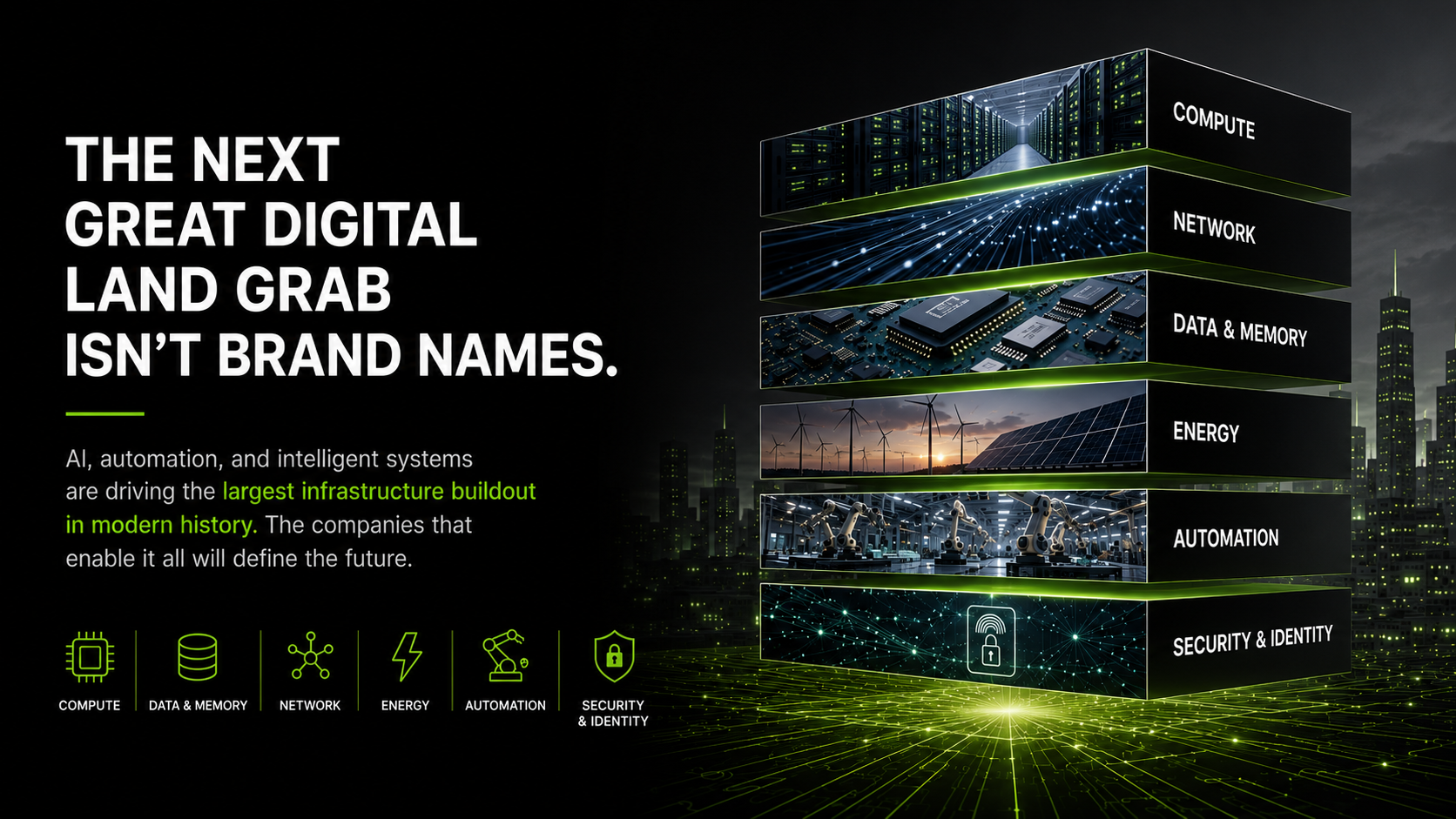
For nearly three decades, the domain industry has largely measured value through the lens of brands. That made perfect sense. The commercial internet emerged during an era when success was determined by consumer adoption, and consumer adoption rewarded names that were short, memorable, and easy to trust. The most celebrated domain sales reflected that reality. Companies wanted names that could appear in television commercials, on billboards, in magazine advertisements, and eventually at the top of search results. A premium domain became a digital storefront, and the best storefronts attracted the greatest attention. Even today, there is little debate that exceptional brand domains deserve exceptional valuations. They have proven their worth repeatedly, and they will likely continue to do so for decades to come.
What has changed is not the value of great brands. What has changed is the economy surrounding them. The internet that rewarded consumer branding above everything else is no longer the only internet being built. Quietly, almost beneath the surface, another layer of the digital economy has begun expanding at extraordinary speed. It is less visible to consumers but vastly more important to governments, manufacturers, defense organizations, utilities, cloud providers, financial institutions, and enterprise software companies. It is the infrastructure that powers artificial intelligence, autonomous systems, industrial automation, digital identity, robotics, advanced manufacturing, and modern computing. While consumers continue to debate the latest AI chatbot or image generator, the world’s largest companies are spending unprecedented amounts of money building the systems that make those applications possible.
Every major technological revolution has followed this pattern. History remembers the products because products are what people see. We remember the automobile, not the steel mills that supplied it. We remember electric lighting, not the transmission networks that carried electricity across entire nations. We remember smartphones, not the semiconductor fabrication plants, fiber optic cables, wireless towers, and satellite networks that made mobile computing possible. The public naturally focuses on what appears at the surface because that is what changes daily life. Investors, however, often discover that the deepest and most durable value is created several layers below, where infrastructure quietly enables everything built above it.
Artificial intelligence is beginning to reveal the same dynamic. Public attention remains concentrated on applications because applications are tangible. They write emails, generate images, summarize documents, answer questions, and increasingly perform work that once required human expertise. Yet those applications represent only the visible portion of an enormous technological system. Every significant advance in artificial intelligence depends upon an expanding foundation of compute capacity, networking, advanced memory, semiconductor manufacturing, electrical generation, cooling technology, software orchestration, and physical facilities measured not in office space, but in gigawatts. The further artificial intelligence advances, the more dependent it becomes on infrastructure that most people will never directly see.
That distinction matters because infrastructure follows a different economic model than consumer technology. Consumer products compete for attention. Infrastructure competes for necessity. A successful social media platform hopes users spend another hour on its service. A successful cloud provider hopes thousands of businesses cannot operate without it. Consumer software succeeds by attracting users. Infrastructure succeeds by becoming indispensable. Once an infrastructure platform becomes deeply embedded within the operations of governments or enterprises, replacing it often becomes expensive, disruptive, and strategically undesirable. That durability explains why infrastructure businesses have historically produced some of the most valuable companies in the global economy.
The scale of today’s investment suggests that artificial intelligence has entered precisely that stage. Technology companies are committing hundreds of billions of dollars to new data centers, semiconductor procurement, networking equipment, optical interconnects, and electrical infrastructure. Governments are introducing sovereign AI initiatives that focus not simply on algorithms but on domestic compute capacity, energy resilience, semiconductor production, and secure digital infrastructure. Utilities are redesigning portions of their long-term planning around anticipated AI demand. Industrial companies are modernizing factories with autonomous systems that require entirely new layers of software coordination. Defense organizations are investing in autonomous platforms, sensor fusion, electronic warfare, and machine decision support at a pace that would have been difficult to imagine only a few years ago. Regardless of which AI models ultimately dominate, the infrastructure supporting them continues to expand.
This transition represents more than another technology cycle. It represents a shift in where value is being created. During the early commercial internet, enormous value accumulated around consumer brands because consumer attention was scarce. Today, computational capacity, reliable energy, industrial automation, trusted digital identity, and intelligent coordination are becoming the scarce resources. As scarcity changes, so too does the language surrounding it. Entirely new categories are emerging to describe technologies that scarcely existed a decade ago. Terms such as physical AI, inference infrastructure, machine identity, orchestration platforms, deployment control planes, infrastructure operating systems, digital twins, and sovereign compute have rapidly entered engineering discussions, government strategies, and enterprise roadmaps. They are no longer isolated technical concepts. Increasingly, they are becoming categories around which companies are organizing themselves.
One of the most overlooked characteristics of every technological revolution is that markets must first develop a common language before they can develop efficiently. Investors cannot measure categories that lack accepted definitions. Customers cannot compare competing products if every company describes similar technology differently. Analysts cannot estimate market size until terminology stabilizes. Recruiters struggle to hire for roles that have no widely accepted names. Standardized language is often treated as an afterthought, yet it quietly becomes part of the infrastructure itself. Once industries agree on common terminology, innovation accelerates because everyone begins speaking the same language.
Cloud computing provides one of the clearest examples. Before the phrase became universally accepted, companies described remarkably similar ideas using a wide variety of terms including hosted infrastructure, utility computing, on-demand infrastructure, grid computing, and managed hosting. Those descriptions often referred to overlapping concepts, but the lack of common language created confusion throughout the market. Eventually, the industry converged around a single category name. Once that happened, customers understood what they were buying, analysts began publishing market research, investors funded specialists, conferences emerged around the category, universities incorporated the subject into their curricula, and entirely new generations of companies were built within that shared framework. The technology certainly mattered, but so did the language that allowed the market to organize around it.
The same pattern has repeated throughout the history of enterprise technology. Cybersecurity was once a collection of unrelated products addressing isolated technical problems. Over time, the industry developed recognizable categories such as endpoint protection, identity and access management, threat intelligence, zero trust, cloud security, and security operations. Those terms became far more than marketing language. They became organizational structures for investment, procurement, regulation, research, education, and corporate strategy. Today, companies proudly describe themselves using those categories because the market immediately understands what they do. Very few people remember the competing terminology that existed before consensus emerged, but nearly every successful enterprise technology market has gone through the same process.
Artificial intelligence now appears to be entering a similar phase. The underlying technology continues to evolve rapidly, but something equally important is happening alongside it: the vocabulary is expanding. Engineers are introducing new concepts to describe increasingly sophisticated systems. Governments are writing policies around infrastructure that barely existed a few years ago. Enterprises are creating job titles and organizational structures around technologies that remain unfamiliar to much of the public. Venture capital firms are funding companies that define themselves using terminology many investors have never encountered before. None of this guarantees that today’s language will survive unchanged. Some phrases will disappear, others will merge, and entirely new concepts will emerge. That uncertainty is not a weakness. It is one of the defining characteristics of markets that are still being formed.
This evolution in language has important implications because infrastructure companies think differently about identity than consumer businesses do. A consumer brand competes for attention in crowded markets where emotional connection, memorability, and differentiation are often the primary objectives. An infrastructure company operates under a different set of incentives. Its customers are evaluating reliability, security, interoperability, regulatory compliance, technical capability, and long-term stability. Decisions often involve procurement committees, technical evaluations, pilot programs, and contracts measured in years rather than months. The conversation is less about attracting attention than about establishing confidence. Every aspect of communication—from technical documentation to product naming—reflects that reality.
That does not mean descriptive names are inherently superior to invented brands. History clearly demonstrates otherwise. Some of the world’s most successful infrastructure businesses have built extraordinary value behind distinctive names that carried little inherent meaning when they were first introduced. NVIDIA, Cisco, Oracle, VMware, Snowflake, Databricks, and Cloudflare all invested heavily in creating recognizable identities that eventually became synonymous with their respective markets. Strong brands remain incredibly powerful assets. The point is not that infrastructure companies reject branding, but that they frequently assign greater importance to category clarity than consumer companies do. Their audiences often want immediate understanding before they develop emotional attachment.
As new infrastructure markets emerge, that distinction becomes increasingly meaningful. A startup introducing technology for autonomous factory orchestration, machine identity, industrial reasoning, or inference networking must often educate customers about an entirely new category before it can explain why its own product is different. Every additional layer of explanation increases friction. Every familiar term reduces it. That dynamic has existed throughout the history of enterprise technology, and it is likely to become even more pronounced as artificial intelligence creates increasingly specialized infrastructure markets.
The capital markets provide another reason to think differently about this transition. Over the past decade, many of the world’s most valuable technology companies have become foundational infrastructure providers rather than purely consumer businesses. NVIDIA supplies the processors driving modern artificial intelligence. Amazon Web Services provides cloud infrastructure supporting millions of organizations. Microsoft Azure has become deeply embedded within enterprise computing. Equinix operates critical interconnection facilities that enable global digital communication. Cloudflare secures and accelerates internet traffic across enormous portions of the web. Palantir has become deeply integrated into government and commercial operations where software increasingly serves as operational infrastructure rather than office productivity. Although these businesses operate in different markets, they share a common characteristic: they enable thousands of other organizations to function more effectively.
Infrastructure businesses often compound value differently than consumer businesses. A successful consumer application may enjoy explosive adoption but face equally rapid changes in user preferences. Infrastructure, by contrast, frequently becomes more valuable as additional systems depend upon it. Integration creates switching costs. Ecosystems become increasingly interconnected. Customers invest time, capital, and expertise into implementation. Over years, the infrastructure itself becomes part of the operating environment rather than merely another vendor relationship. This durability helps explain why infrastructure companies often remain central to the economy long after individual consumer products have faded from public attention.
Domains occupy an interesting position within this discussion because they are typically viewed through a marketing lens. That perspective is understandable. A domain is often the first interaction customers have with a company, and memorable names unquestionably possess branding advantages. Yet premium domains also perform another function. They become permanent reference points within an industry. They influence how companies describe themselves, how journalists write about emerging markets, how investors remember categories, how developers search for technologies, and how customers discover solutions. Unlike advertising campaigns, websites, logos, or product messaging, an exact category-defining domain cannot be replicated. There is only one exact .com corresponding to a particular phrase. As industries mature, that scarcity becomes increasingly apparent because the number of companies grows while the number of exact category-defining domains remains fixed.
Scarcity alone does not create value. Plenty of scarce assets have little economic importance. Scarcity becomes meaningful only when demand develops around something people genuinely need. That is precisely why understanding technological change matters more than simply identifying attractive words. Throughout history, markets have repeatedly demonstrated that categories capable of supporting significant economic activity eventually develop demand for the language that defines them. Companies compete to establish leadership within those categories, investors allocate capital toward them, analysts publish research around them, and customers search for them using increasingly standardized terminology. Language gradually becomes part of the commercial infrastructure surrounding the technology itself.
The domain market has always reflected the broader economy, although not always immediately. During the rise of the commercial internet, premium consumer brands understandably attracted the greatest attention because that was where the largest opportunities existed. The companies transforming commerce, search, social media, online payments, travel, and entertainment all needed memorable identities capable of reaching hundreds of millions of consumers. Those businesses helped establish many of the pricing assumptions that continue to shape the domain industry today. They also created a generation of investors who naturally evaluate digital assets through the lens of consumer branding because that framework proved remarkably successful.
The question facing the market today is whether those assumptions fully reflect the economy that is now emerging. Artificial intelligence has accelerated investment in computing infrastructure at a pace rarely seen outside of wartime industrial expansion or the construction of national utility networks. Governments are treating compute capacity as a strategic resource. Energy companies are redesigning long-term planning around anticipated demand from data centers. Semiconductor manufacturers are investing unprecedented amounts of capital into fabrication capacity. Telecommunications providers are expanding high-speed connectivity. Defense organizations are modernizing around autonomous systems, machine intelligence, and software-defined operations. Industrial companies are redesigning factories around intelligent automation. The center of gravity has shifted from applications alone toward the infrastructure required to support them.
That shift raises an interesting possibility. If infrastructure increasingly becomes the foundation of economic growth, then the language describing that infrastructure may also become more strategically important. Not because words possess intrinsic value by themselves, but because language shapes how markets organize. Every enduring industry eventually develops a vocabulary that customers understand, investors recognize, regulators reference, educators teach, and journalists adopt. Those categories become part of the commercial architecture of the economy. The names associated with them are no longer merely descriptive. They become shorthand for entire markets.
This perspective also helps explain why evaluating infrastructure domains differs from evaluating speculative technology buzzwords. Every technological cycle produces thousands of fashionable phrases that disappear almost as quickly as they emerge. Most deserve to disappear because they describe products rather than enduring categories. Lasting value generally comes from identifying the concepts that remain relevant regardless of which individual company ultimately wins. Cloud computing survived countless competitive battles because the category itself proved indispensable. Cybersecurity remained central despite constant changes among market leaders. Digital payments continued growing while individual payment companies rose and fell. Categories often outlive the businesses that initially popularized them.
Artificial intelligence is likely to produce similar outcomes. Many of today’s startups will disappear. Some technologies will prove less important than expected. Other innovations that receive little attention today may become foundational over the next decade. Predicting individual winners will remain extraordinarily difficult. Identifying broad infrastructure trends, however, may be considerably easier because they are driven by structural forces rather than quarterly product announcements. Compute requirements will continue expanding. Identity will become increasingly important as autonomous systems proliferate. Energy and data infrastructure will remain central to scaling artificial intelligence. Industrial automation will continue reshaping manufacturing. Governments will continue viewing critical digital infrastructure through the lens of national competitiveness and security. Those trends extend well beyond any single company or product cycle.
For that reason, we believe infrastructure deserves to occupy a much larger place in conversations about premium digital assets. This is not an argument against brand domains. Exceptional brands will always command exceptional value because businesses will always compete for reputation, recognition, and customer loyalty. Instead, it is an argument that another class of premium assets is emerging alongside them. As entirely new infrastructure categories become established, the language defining those categories may become increasingly strategic for the organizations building within them. The market does not need to abandon one framework to recognize another. Both can exist simultaneously because they solve different problems.
The broader lesson extends beyond domains. Every technological revolution creates new physical infrastructure, new software, new institutions, new standards, and eventually a new vocabulary. That vocabulary becomes embedded within investment research, procurement processes, engineering disciplines, regulatory frameworks, university programs, and public discourse. Once those terms become widely accepted, they rarely disappear. They evolve, expand, and gradually become part of the permanent language of the economy. Looking backward, this process appears almost inevitable. Looking forward, it often remains difficult to recognize while it is happening.
We believe the artificial intelligence era is approaching that moment today. The conversation is gradually shifting away from individual applications and toward the infrastructure enabling them. The companies creating long-term value are increasingly those building compute platforms, networking technologies, industrial systems, energy solutions, identity frameworks, robotics, and software capable of coordinating increasingly complex physical and digital environments. As those markets mature, the language describing them is likely to mature as well.
At ByeGig, this observation has shaped the way we think about premium domains. Rather than focusing exclusively on yesterday’s internet, we believe the more interesting question is how tomorrow’s economy will describe itself. Every generation creates its own foundational industries, and every foundational industry eventually develops a common language. If artificial intelligence represents one of the largest infrastructure buildouts in modern history, then the vocabulary defining that infrastructure deserves careful attention. We believe the next great digital land grab may not be centered on consumer brands alone, but on the language of the infrastructure that future industries cannot operate without.
ByeGig
