
Infrastructure Thesis Series: The Sovereign Compute Era
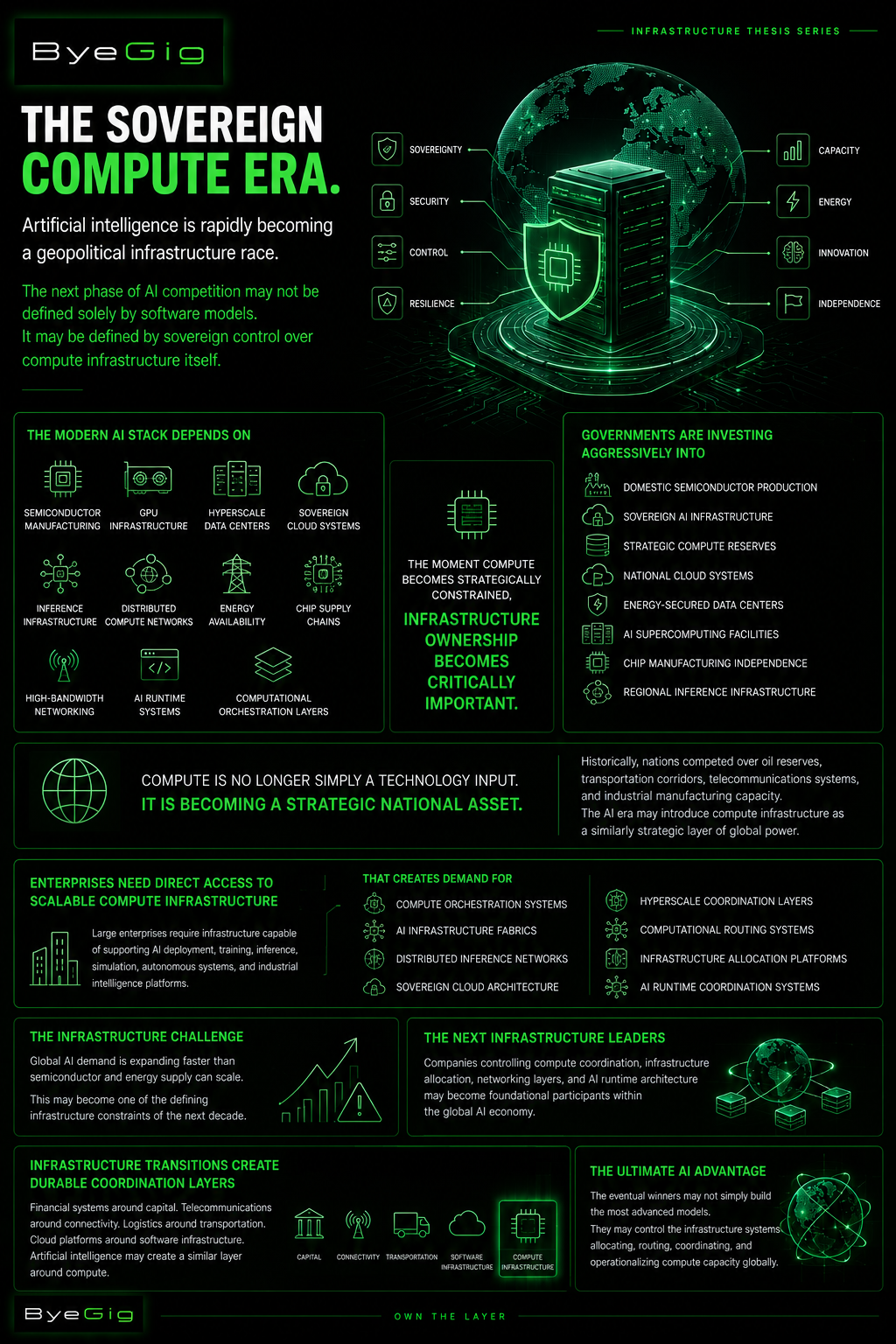
Artificial intelligence is rapidly becoming a geopolitical infrastructure race.
The next phase of AI competition may not be defined solely by software models.
It may be defined by sovereign control over compute infrastructure itself.
As advanced AI systems scale globally, nations and enterprises are increasingly recognizing that compute capacity is becoming a strategic resource.
This transition fundamentally changes the role of semiconductors, data centers, cloud systems, energy infrastructure, and AI networking architecture.
The modern AI stack increasingly depends upon: • semiconductor manufacturing • GPU infrastructure • hyperscale data centers • sovereign cloud systems • inference infrastructure • distributed compute networks • energy availability • chip supply chains • high-bandwidth networking • AI runtime systems • computational orchestration layers
The moment compute becomes strategically constrained, infrastructure ownership becomes critically important.
This is already reshaping global industrial policy.
Governments are investing aggressively into: • domestic semiconductor production • sovereign AI infrastructure • strategic compute reserves • national cloud systems • energy-secured data centers • AI supercomputing facilities • chip manufacturing independence • regional inference infrastructure
Compute is no longer simply a technology input.
It is becoming a strategic national asset.
Historically, nations competed over oil reserves, transportation corridors, telecommunications systems, and industrial manufacturing capacity.
The AI era may introduce compute infrastructure as a similarly strategic layer of global power.
This transition extends beyond governments themselves.
Large enterprises increasingly require direct access to scalable compute infrastructure capable of supporting AI deployment, training, inference, simulation, autonomous systems, and industrial intelligence platforms.
That creates demand for: • compute orchestration systems • AI infrastructure fabrics • distributed inference networks • sovereign cloud architecture • hyperscale coordination layers • computational routing systems • infrastructure allocation platforms • AI runtime coordination systems
The infrastructure challenge becomes increasingly complex as global AI demand expands faster than semiconductor and energy supply can scale.
This may become one of the defining infrastructure constraints of the next decade.
The companies controlling compute coordination, infrastructure allocation, networking layers, and AI runtime architecture may become foundational participants within the global AI economy.
Historically, infrastructure transitions create durable coordination layers around the underlying resource itself: financial systems around capital, telecommunications around connectivity, logistics around transportation, cloud platforms around software infrastructure.
Artificial intelligence may create a similar coordination layer around compute.
The eventual winners may not simply build the most advanced models.
They may control the infrastructure systems allocating, routing, coordinating, and operationalizing compute capacity globally.
ByeGig
