
The Emerging Infrastructure Map
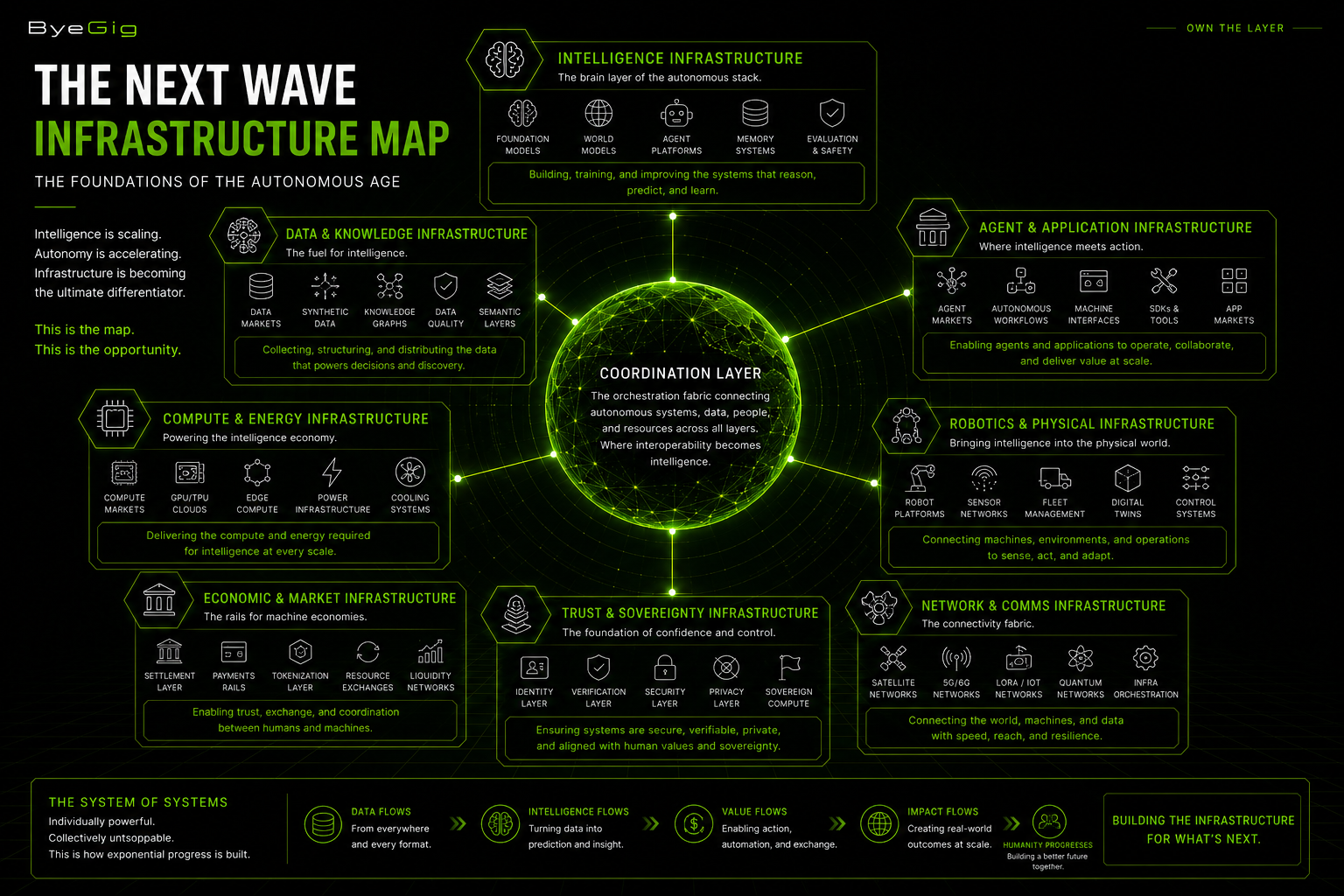
One of the more curious features of technological change is that people rarely recognize the larger pattern while they are living through it.
Instead, they experience a collection of seemingly independent developments that attract attention for different reasons. Investors discuss artificial intelligence. Defense analysts discuss autonomous systems. Utilities discuss power demand. Governments discuss industrial policy. Space companies discuss launch costs. Financial institutions discuss automation and digital settlement. Cybersecurity professionals discuss identity verification and fraud.
Each conversation appears distinct.
Each industry develops its own language.
Each group of specialists focuses on its own challenges.
Only later does it become obvious that many of these developments were components of the same transformation.
The railroad era was not fundamentally about trains. It was about the integration of markets, the movement of goods, the formation of national economies, and the emergence of industrial scale. Electricity was not fundamentally about power generation. It was about the ability to distribute energy in a way that transformed manufacturing, transportation, communications, and daily life. The internet was not fundamentally about websites. It was about the creation of a global information infrastructure that fundamentally altered how knowledge, commerce, media, and communication moved through society.
In each case, the technologies attracted attention. The infrastructure altered civilization.
We believe a similar process may be underway today.
Artificial intelligence, advanced computing, robotics, autonomous systems, energy infrastructure, trust and identity systems, financial modernization, and orbital infrastructure are often discussed as separate trends. Yet viewed from sufficient distance, they begin to resemble components of a much larger system. The common thread connecting them is not any single technology. The common thread is infrastructure.
The world is increasingly building systems for coordinating intelligence, capital, energy, machines, information, and trust at unprecedented scale. Understanding that shift may prove more important than understanding any individual breakthrough.
The reason is simple. Technologies can be replaced. Infrastructure tends to persist.
Throughout history, societies have repeatedly constructed infrastructure layers that outlast the technologies that originally motivated them. Rail infrastructure survived generations of locomotives. Electrical infrastructure survived generations of power technologies. Communications infrastructure survived countless shifts in hardware and software. Once infrastructure reaches sufficient scale, it becomes a foundation upon which future innovation occurs.
The most important question therefore may not be which technologies succeed.
The more important question may be which infrastructure systems become indispensable.
Artificial intelligence provides perhaps the clearest example. Much of the current discussion revolves around models, applications, and software capabilities. These developments are significant, but they represent only the visible layer of a much larger economic story. Beneath every model sits an extraordinary physical infrastructure footprint. Semiconductor fabrication plants, electrical generation assets, transmission systems, networking equipment, data centers, cooling systems, and compute clusters all become increasingly important as artificial intelligence scales.
The economic implications are difficult to overstate. For decades, computing power functioned largely as a technical resource. Today it is beginning to resemble a strategic resource. Governments are discussing national compute capacity. Infrastructure funds are investing in data centers. Utilities are revising long-term demand forecasts. Entire regions are competing to attract computational infrastructure. These are not normal technology-sector dynamics. They are infrastructure dynamics.
History suggests that once a resource reaches this level of importance, societies begin constructing increasingly sophisticated systems around it. Markets emerge. Governance frameworks emerge. Allocation mechanisms emerge. Institutions emerge. Entire categories that previously seemed unnecessary suddenly become essential.
This is why sovereign compute has become such an important concept. It is not merely a technology discussion. It is a recognition that computational capacity may increasingly influence economic competitiveness, scientific advancement, military capability, industrial productivity, and national resilience.
Yet compute represents only one part of a larger map.
Physical AI may represent another.
For years, artificial intelligence existed primarily within digital environments. It generated text, analyzed information, optimized workflows, and performed tasks within software systems. Increasingly, intelligence is moving into the physical world. Robots, autonomous vehicles, industrial systems, drones, logistics platforms, and machine-operated infrastructure are becoming increasingly capable.
This transition introduces entirely new challenges. A digital model can operate independently. A population of millions of autonomous systems requires coordination. Machines require identity systems, communications systems, update systems, security systems, deployment frameworks, operational oversight, and command architectures. The future of robotics may ultimately depend as much on coordination infrastructure as on the machines themselves.
This pattern appears repeatedly throughout technological history. As complexity increases, coordination becomes increasingly valuable. As coordination becomes valuable, infrastructure emerges to support it.
The same logic applies to trust.
Trust is often discussed as though it were a social concept rather than an infrastructure category. Historically, trust was embedded within institutions. Governments issued credentials. Banks verified identities. Educational institutions certified qualifications. Media organizations acted as intermediaries between information and audiences.
Artificial intelligence is changing the economics of information production. Images, video, audio, documents, and even identities can increasingly be generated, modified, and replicated at scale. The result is that authenticity itself becomes increasingly valuable. Verification, provenance, authentication, identity, and trust may evolve into infrastructure categories of their own.
This possibility is often underestimated because trust feels intangible. Yet history demonstrates that economies routinely build infrastructure around scarce and valuable resources. If trusted information becomes scarce relative to synthetic information, the economic incentive to create verification infrastructure becomes substantial.
Financial systems provide another example of infrastructure evolution.
Much of modern finance was built for a world characterized by slower communication, fragmented data, manual processes, and limited computational capability. Today, financial systems increasingly resemble software systems. Settlement, liquidity management, treasury operations, compliance, risk analysis, and transaction routing are becoming increasingly automated and interconnected.
The implications extend beyond efficiency. As systems become more complex, the need for orchestration increases. Future financial infrastructure may include entirely new coordination layers responsible for directing liquidity, automating settlement, optimizing treasury operations, and managing capital flows across increasingly interconnected environments. The financial system itself may increasingly resemble a large-scale infrastructure network.
The same pattern extends beyond Earth.
For much of modern history, space was primarily associated with exploration, science, and national prestige. Increasingly, orbital systems are becoming operational infrastructure. Communications, navigation, observation, defense, and potentially even future computing capacity are becoming increasingly dependent upon orbital assets. As these systems scale, entirely new infrastructure requirements emerge. Orbital logistics, traffic management, autonomous coordination, space-based communications architecture, and future orbital economies may require categories that currently appear speculative only because the infrastructure remains early.
The most important observation is not that these categories exist independently.
The most important observation is that they increasingly interact.
Compute requires energy.
Artificial intelligence drives demand for compute.
Physical AI depends on intelligence.
Trust infrastructure becomes more important as AI capabilities improve.
Financial infrastructure becomes increasingly automated as computational capability expands.
Orbital systems support communications, positioning, and coordination.
Each category reinforces the others.
What emerges is not a collection of isolated trends but a network of interconnected infrastructure systems.
This interconnectedness may prove to be one of the defining characteristics of the coming decade. Previous infrastructure eras were often centered around a dominant system. Railroads transformed transportation. Electrical grids transformed industry. Telecommunications transformed communications. Today, multiple infrastructure layers appear to be evolving simultaneously and influencing one another.
This creates both complexity and opportunity.
Organizations that view these developments independently may miss the broader picture. Organizations that understand how these systems interact may be better positioned to anticipate where new categories emerge, where capital accumulates, and where infrastructure bottlenecks develop.
That perspective ultimately explains the purpose of ByeGig.
The objective is not simply to discuss technology.
The objective is not to predict which company wins.
The objective is to identify the infrastructure categories that may emerge as these systems continue converging.
The most valuable opportunities of the next decade may not be individual products. They may be the systems that coordinate products. They may not be applications. They may be infrastructure. They may not be companies. They may be categories.
History suggests that when societies undergo periods of significant transformation, infrastructure becomes the mechanism through which change scales. The technologies capture attention. The infrastructure determines outcomes.
The map remains incomplete. Many categories have not yet fully emerged. Some may never emerge at all. Others may become so fundamental that future generations struggle to imagine a world without them.
The purpose of studying infrastructure is not certainty.
The purpose is recognizing possibility before consensus arrives.
And if the current moment is indeed the beginning of a new infrastructure cycle, the categories that ultimately define it are only beginning to take shape.
ByeGig
