
Infrastructure Thesis Series: Compute Markets
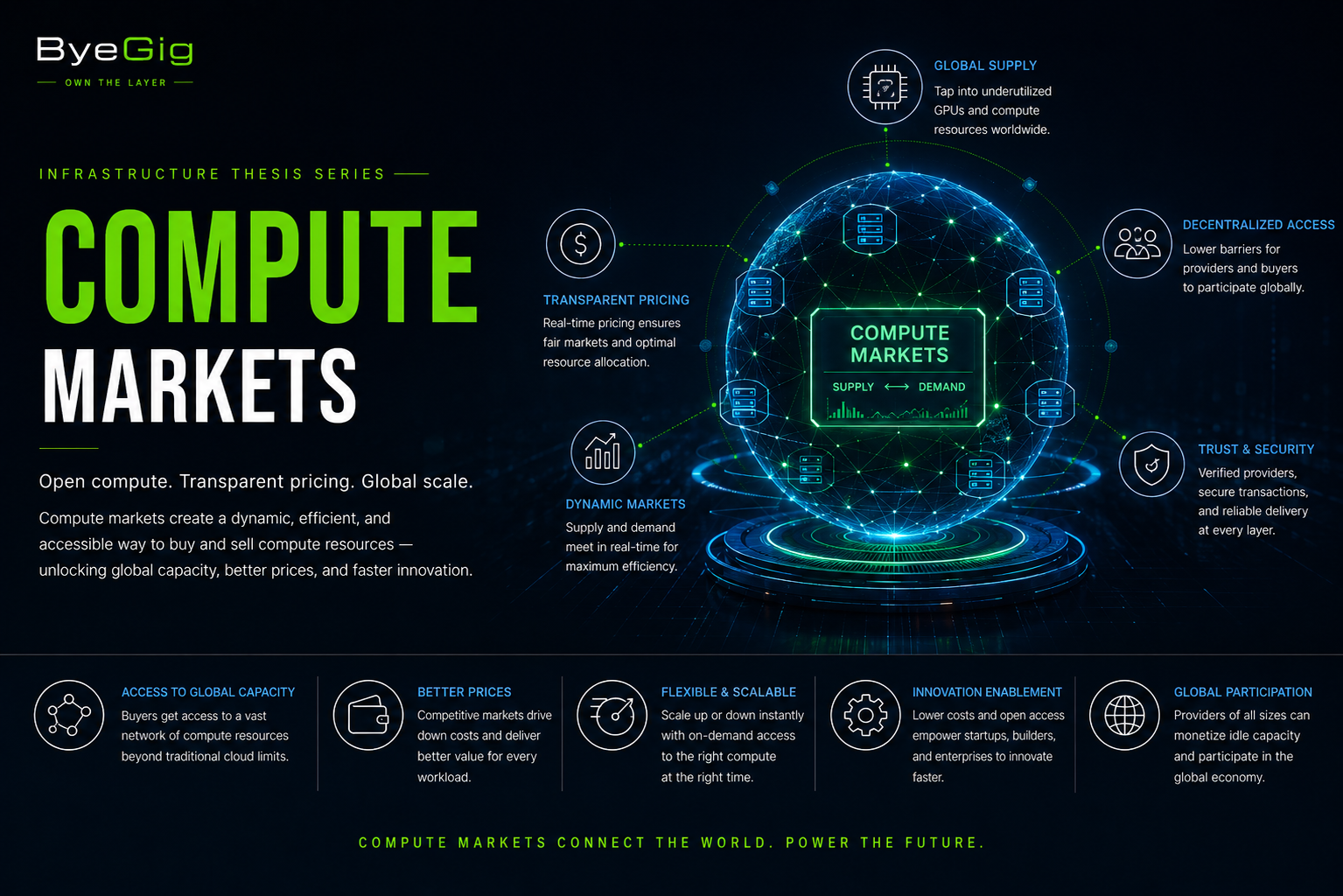
Artificial intelligence is transforming compute into a strategic resource class.
For decades, compute infrastructure primarily operated through centralized ownership models: enterprises purchased servers, hyperscalers built datacenters, and workloads remained relatively predictable.
AI changes this dynamic entirely.
Modern AI systems require enormous quantities of: • GPU capacity • high-bandwidth memory • interconnect infrastructure • inference acceleration • distributed compute coordination • low-latency networking • specialized silicon
Demand is increasingly volatile, global, and strategic.
This creates conditions for the emergence of entirely new compute markets.
The industry is beginning to shift from static infrastructure ownership toward dynamic allocation systems where compute behaves more like an actively traded infrastructure commodity.
This evolution resembles earlier transitions in: • electricity markets • bandwidth exchanges • cloud infrastructure • financial liquidity systems
As compute demand intensifies, infrastructure coordination becomes increasingly valuable.
Organizations may eventually require: • compute exchanges • GPU allocation markets • autonomous compute routing • inference marketplaces • distributed compute federations • sovereign compute systems • AI capacity exchanges
The importance of allocation infrastructure rises dramatically when resources become constrained.
That is increasingly the case across advanced AI compute systems.
The strategic value may ultimately shift beyond the chips themselves toward the systems coordinating: • access • scheduling • routing • prioritization • optimization • settlement • interoperability
The long-term AI economy may depend heavily on infrastructure capable of dynamically coordinating compute resources across global networks.
Compute may increasingly resemble financial liquidity: allocated, routed, prioritized, exchanged, and optimized in real time.
This transition creates an entirely new infrastructure category around the operational coordination of intelligence itself.
The AI era may not simply produce larger datacenters.
It may produce global compute economies.
ByeGig
